
Any liturgical artist who gets to design an altar of repose must surely make it his opus magnum. There is no other liturgical art project that has more leeway for total and utter extravagance. Actually, for an altar of repose, one could say there is no such thing as extravagance.
When the Oratory of Ss. Gregory and Augustine moved into the church of St. Luke the Evangelist, they needed a new idea for their Maundy Thursday Altar of Repose. The previous priest had usually just put a couple of pots of flowers here where the Eucharist was reserved.
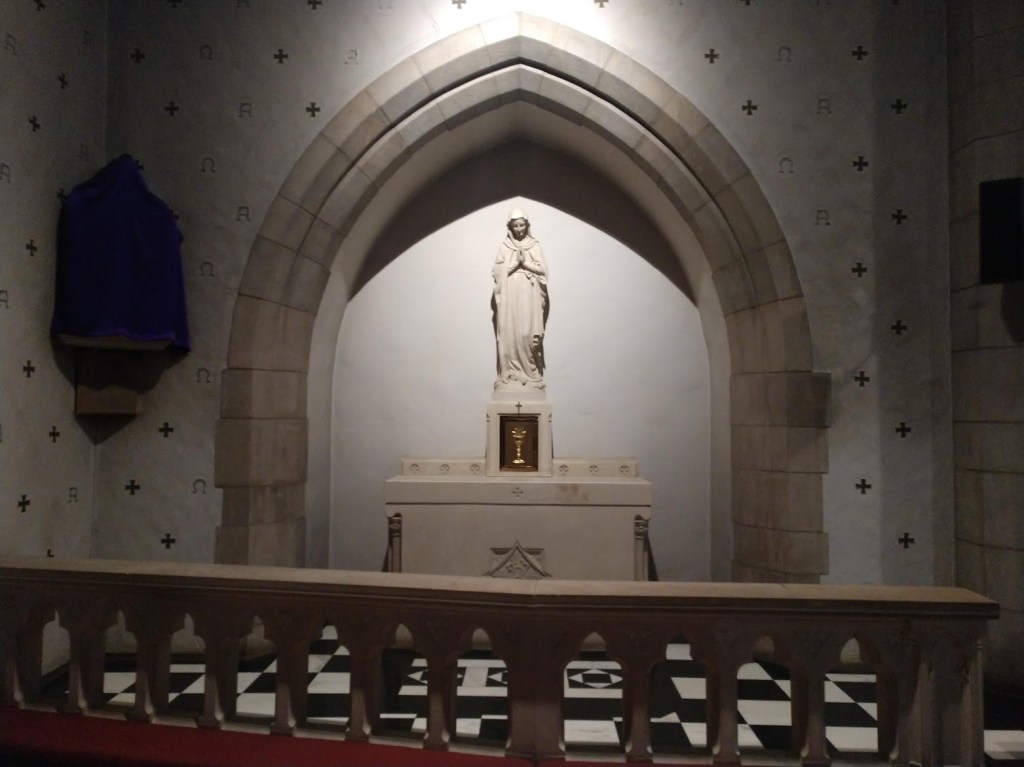
I knew we could do better! Much better!
Before taking you through the creative journey for this Altar of Repose, let’s first look at another photo of what the altar looks like during Passiontide leading up to the Triduum:
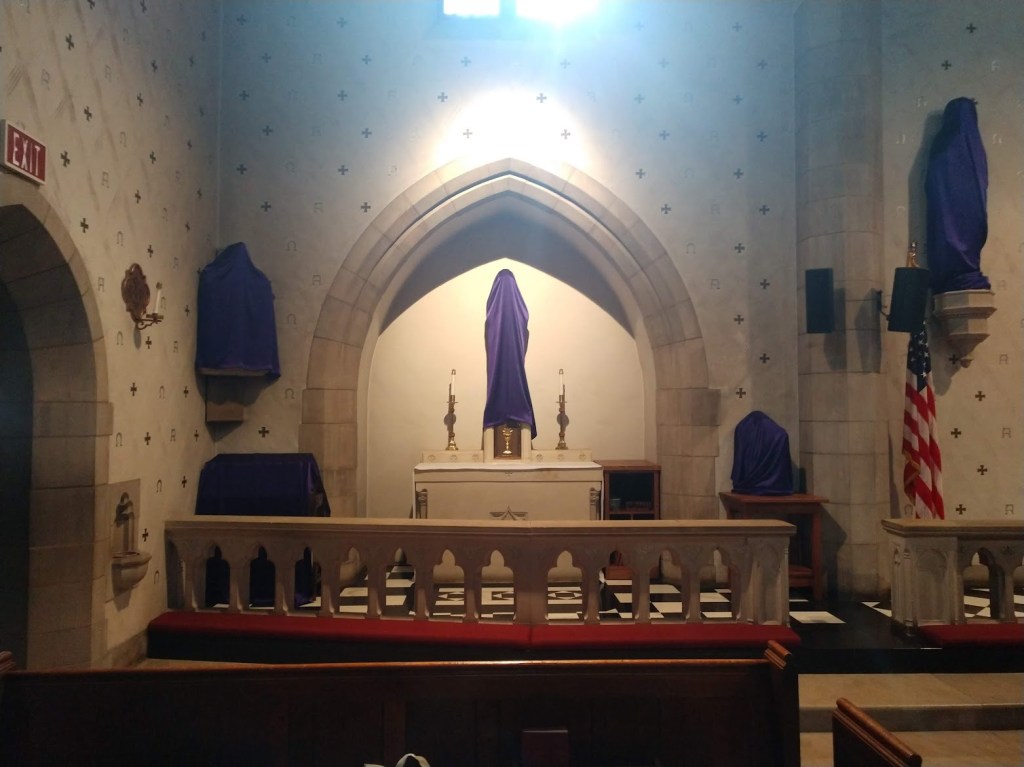
You see, at this point, all statues, crucifixes, and the the candle stand are veiled in purple silk. I point this out because it poses an extra challenge to any liturgical artist who must work with a side altar like this one which features a statue. One must find a way to adorn the altar and highlight the splendor of the Eucharist, while not letting the penitential purple bring a contrasting note to the artistic chord. One cannot simply remove the veil. The statue must remain veiled. Technically, the Altar of Repose need not be at a side altar or even in the church at all, but most communities (especially traditional ones) deem it prudent to use a side altar as the surest way to ensure proper reverence is rendered to the Blessed Sacrament. For instance, a monastery might use the Chapter House (assuming it has similar beautiful architecture to that of the church) for their Altar of Repose, and this would work just fine because all members of the community would understand the extraordinary reverence they must render at the Chapter House during this time. But a parish ought not select the gym or the church hall for such a purpose because the architecture will never be as worthy as that of the church, and the faithful will struggle to render the same kind of reverence in “dressed-up” secular spaces.
But I digress. Getting back to solving the problem with the purple veiled statue of Our Lady at this austere Marian side altar that needed to become a lush and dazzling Altar of Repose.
I knew that an oft-used trick of liturgical artists to circumvent the purple-veil issue was simply to veil the statue(s) in white, but I didn’t see this as ideal. Statues veiled in white at an Altar of Repose look like strange white lumps or hovering satin ghosts, and I knew I didn’t want lumps and ghosts at this Altar of Repose.
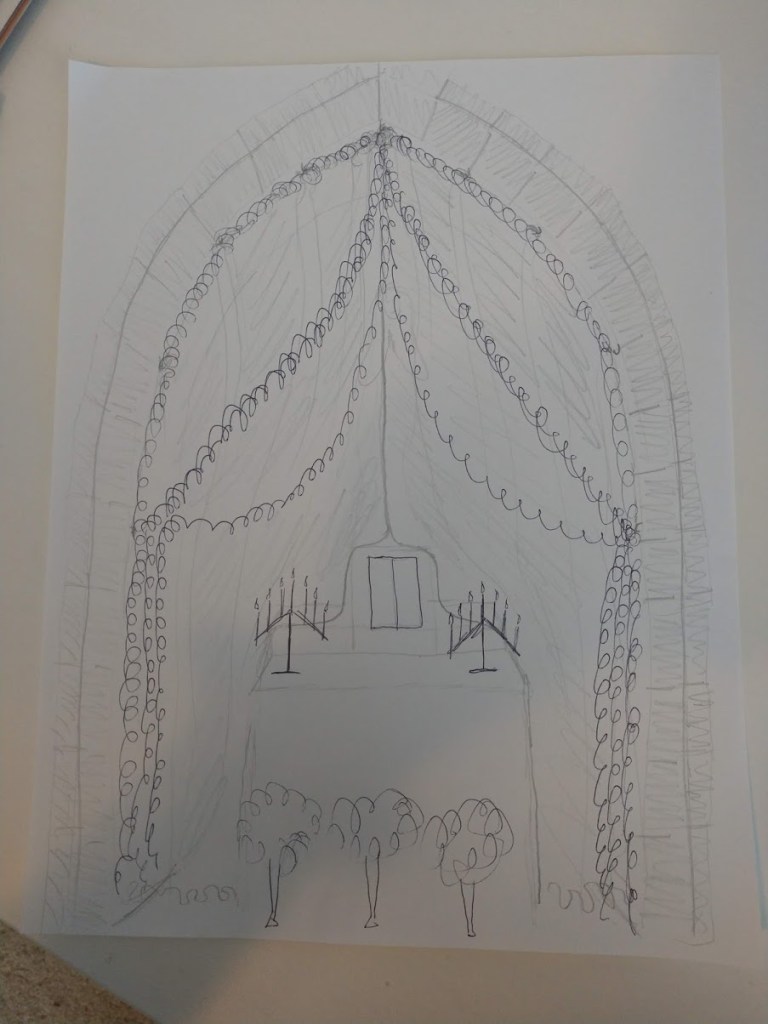
Then it dawned on me that I should hang curtains to fall around the Tabernacle. Draperies (ideally of precious fabrics) are a longstanding tradition in Altars of Repose. I realized that mine would serve a double-purpose; first they would veil Our Lady; and then they would create a glorious frame around the Tabernacle. Here is my initial sketch (you see, I’m not much with the pencil!):
And some very detailed measurements:
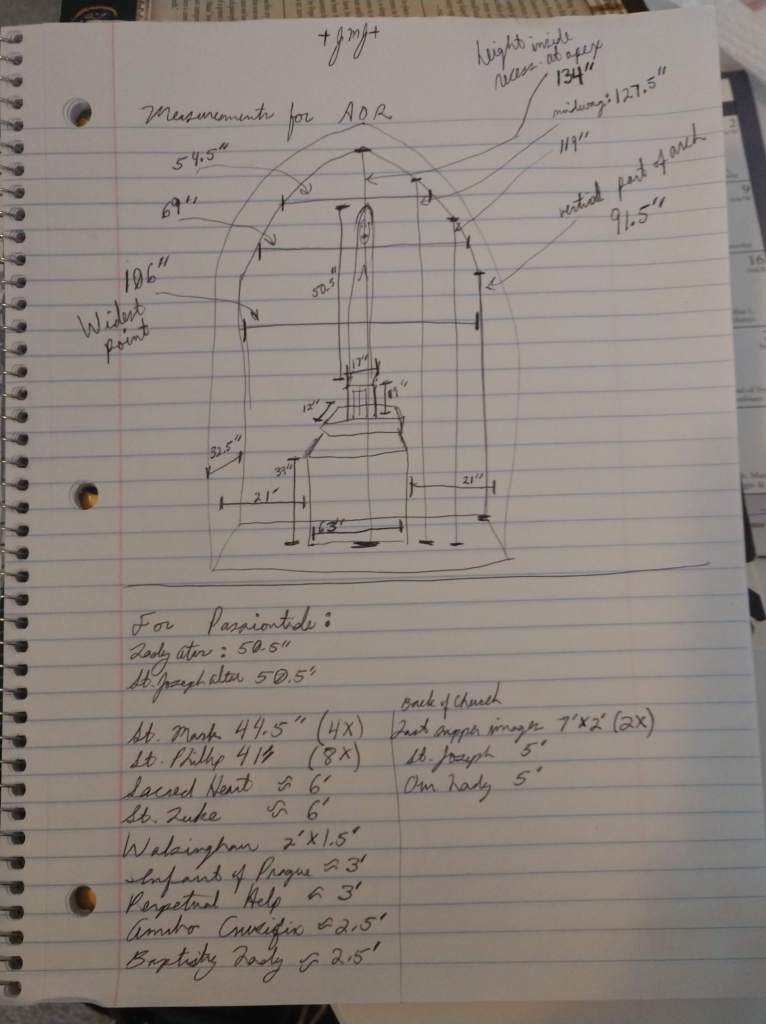
Unwilling to scar the beautiful plaster work of my alcove with a multitude of drilled in hooks, I considered adhesives such as command hooks. However, I kept thinking about just how much fabric I was going to be hanging and having nightmares about drapes falling down mid-liturgy because of failing adhesives. I wanted something totally secure, even earthquake grade!
The solution was a challenging one: To build a custom wooden frame that would fit within the gothic arch of the alcove. I spoke with a carpenter about this (I was doubtful and didn’t have much hope we could ever get wood to bend in the beautiful line of that arch!), but he took the challenge in stride. With well cut two-by-fours, he believed he could make an arch that would approximate the gothic arch (Like certain Calculus problems for the math nerds out there). And my wonderful carpenter agreed to put rounded facade pieces on the front of the frame so that none of the straight lines of the wood were visible. Pictures help. Here is a drawing of the plan:
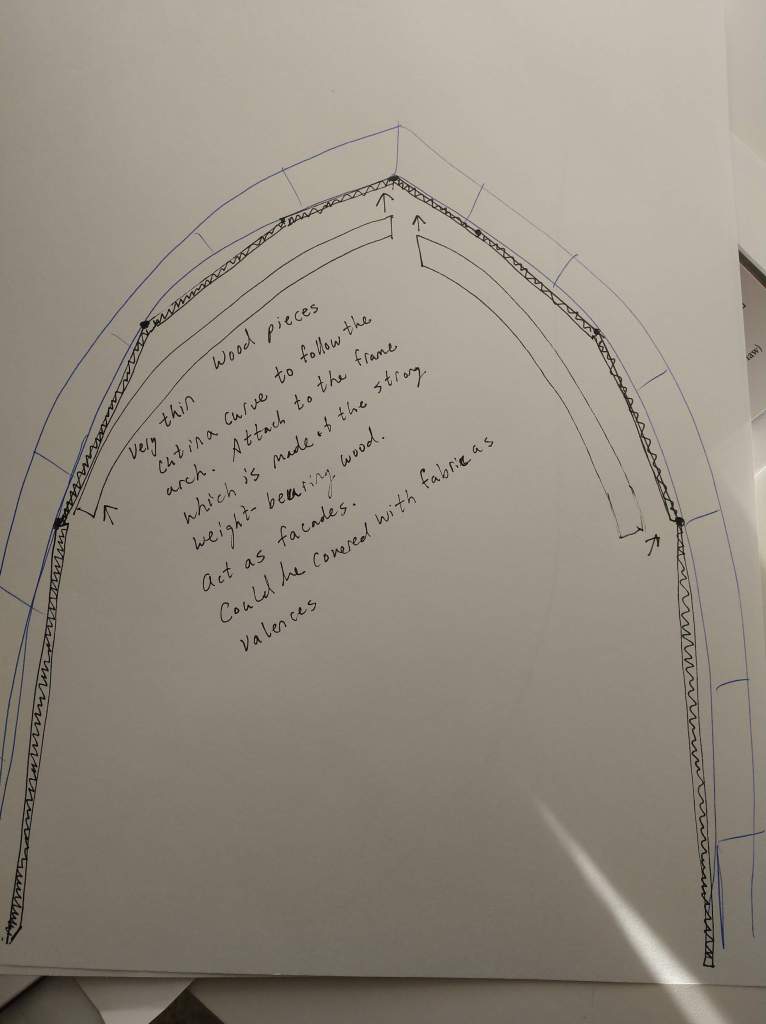
And here the building begins! Note the little gold hooks all along the frame. Perfect for my curtains which have button holes all along their edges.
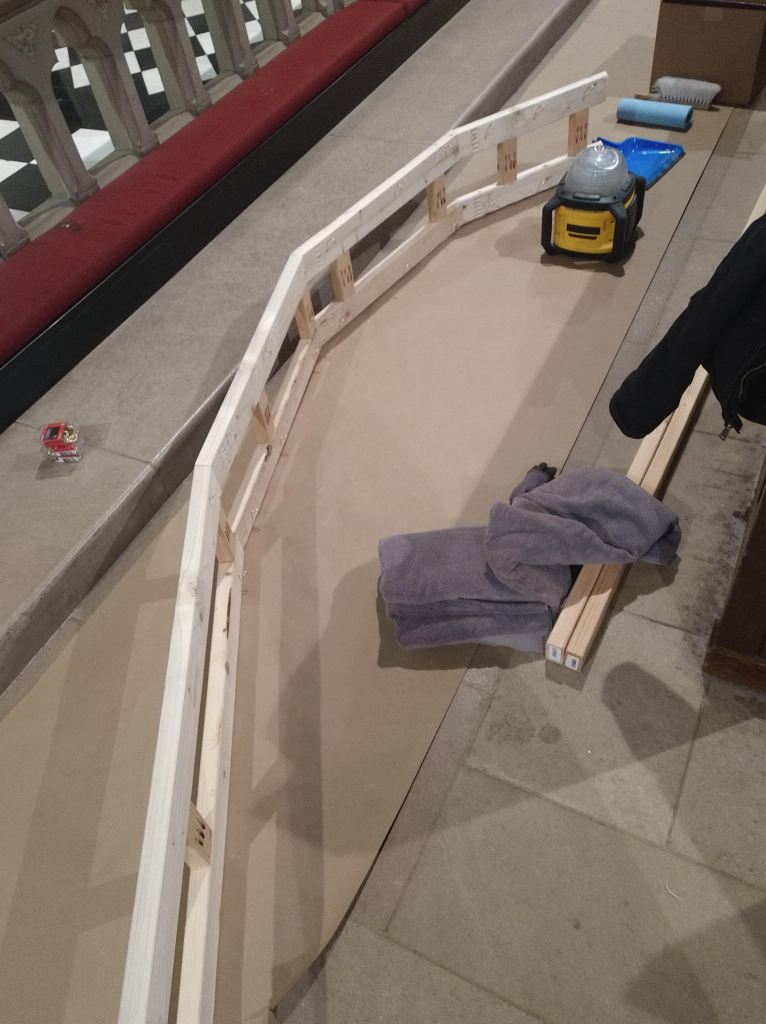
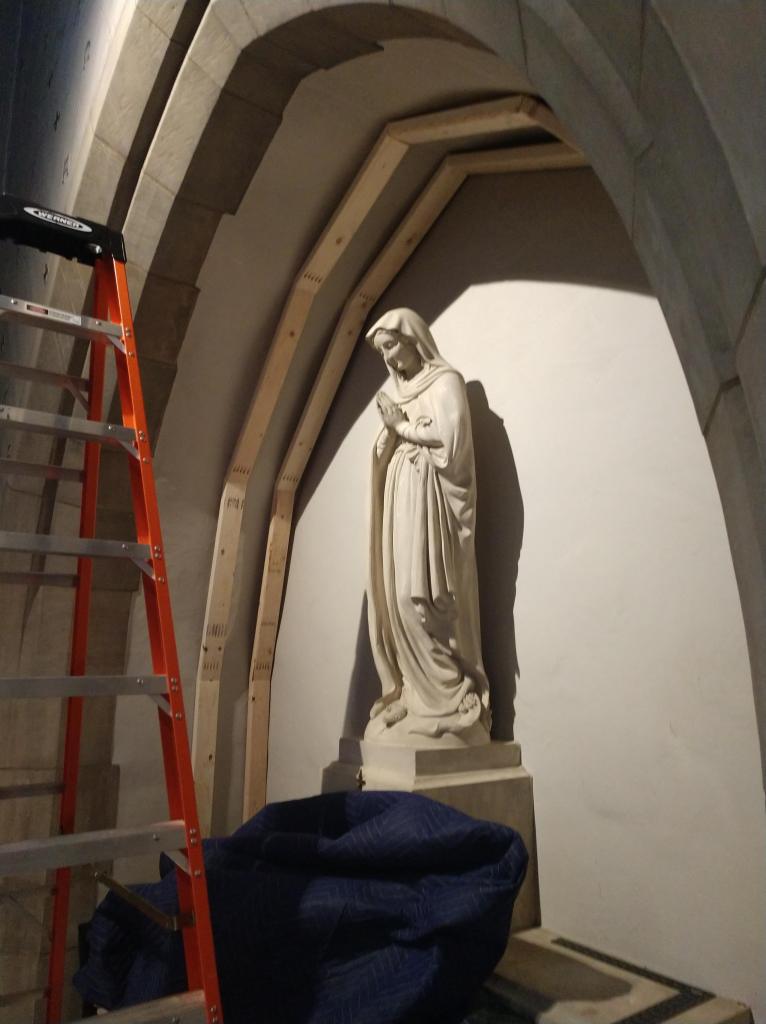
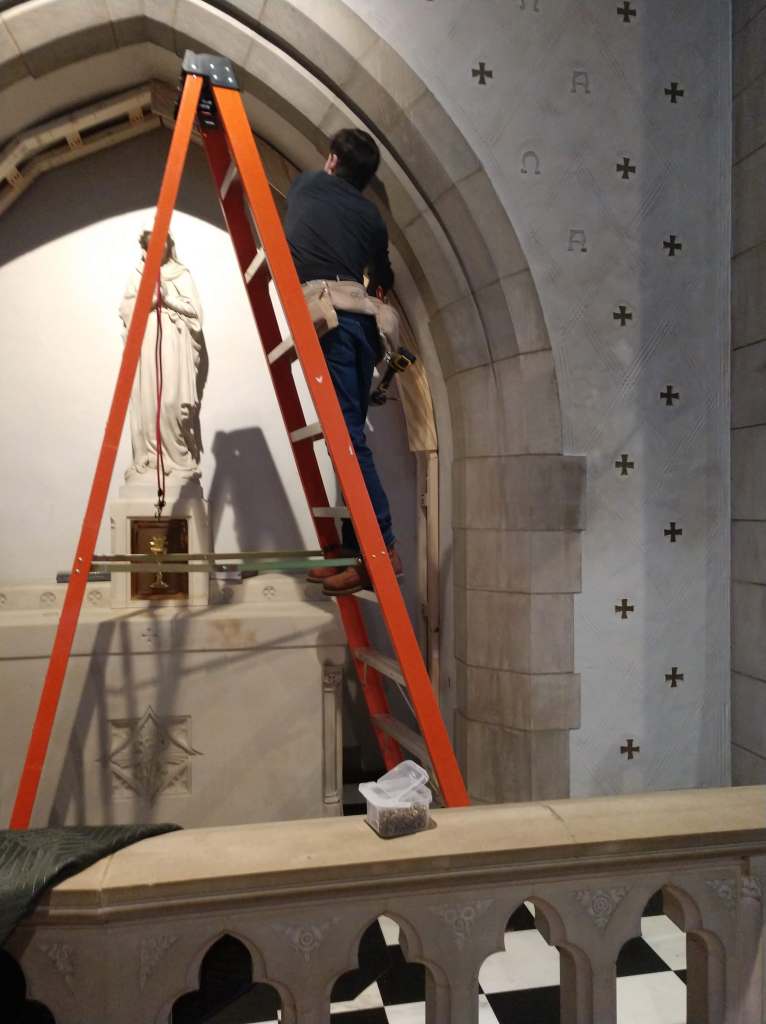
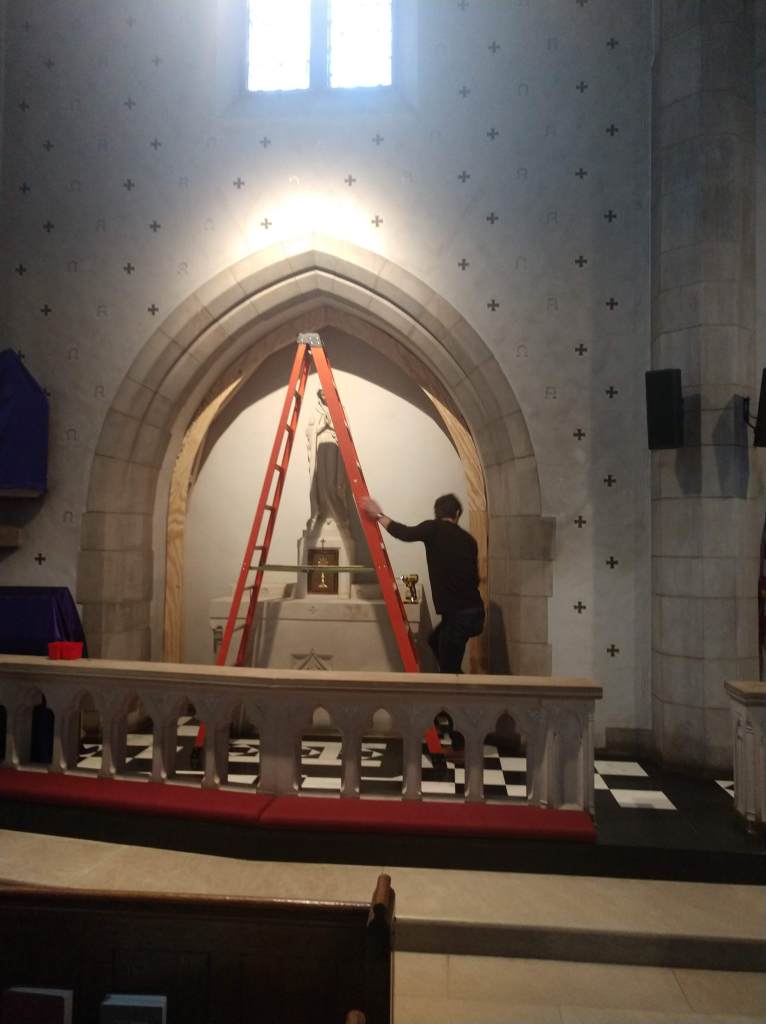
This two piece frame can be removed and stored when one does not need the draperies, and I just love how it did not require us to scar the alcove with screws or hooks of any kind. It is totally stable and can hold very heavy fabric, but it “leaves no trace” when one decides to return to the austere beauty of the alcove sans draperies. Truly successful craftsmanship from my excellent carpenter friend!
Speaking of fabric, I decided on an extra wide bolt white polyester damask. Yes, I am not proud of the polyester part! However, I was nervous about so much fabric being near so many candles, and I (perhaps somewhat irrationally) quelled my fears by choosing polyester for its higher flame retardation than natural fibers such as silk. Looking back on it, I do think it was probably prudent from a sewing standpoint to do these custom drapes in a less expensive material before breaking the bank on silk. Sewing panels for a 134″ gothic arch is not simple! I made some errors in my measurements that would have been costly had I been using a precious fabric. In the future, I will sew silk damask drapes and use these current polyester ones as prototypes.
Anyway, here’s the damask. A good traditional Renaissance pattern. I forget how many yards I ordered. A lot! I still have leftovers of the stuff:
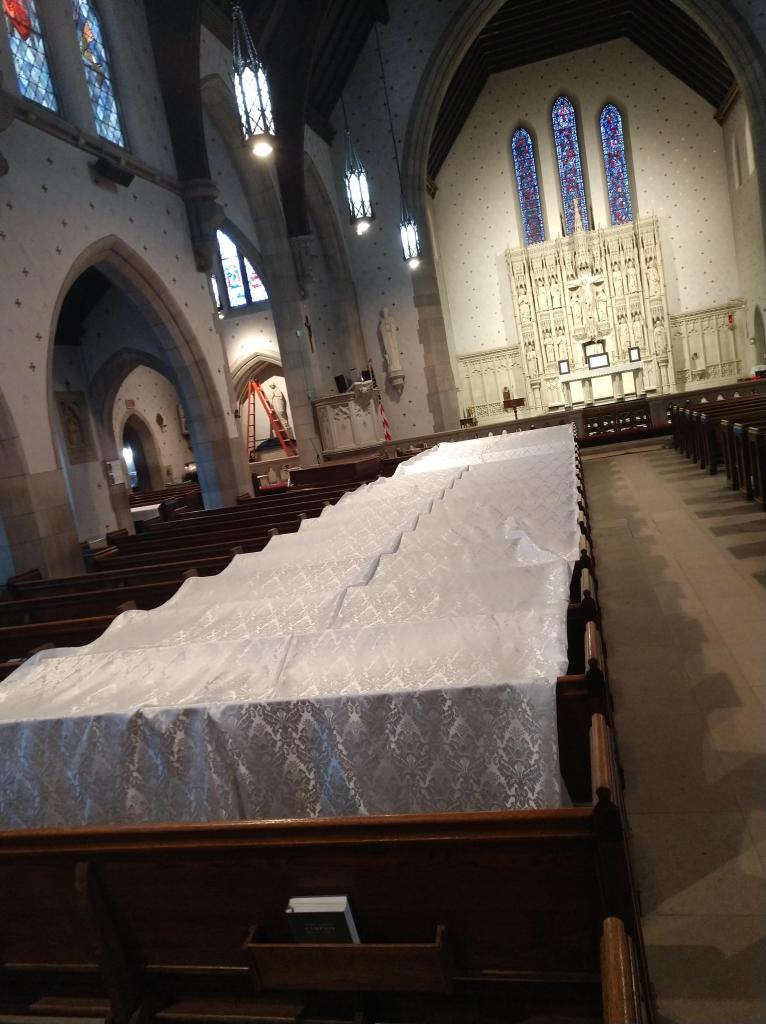
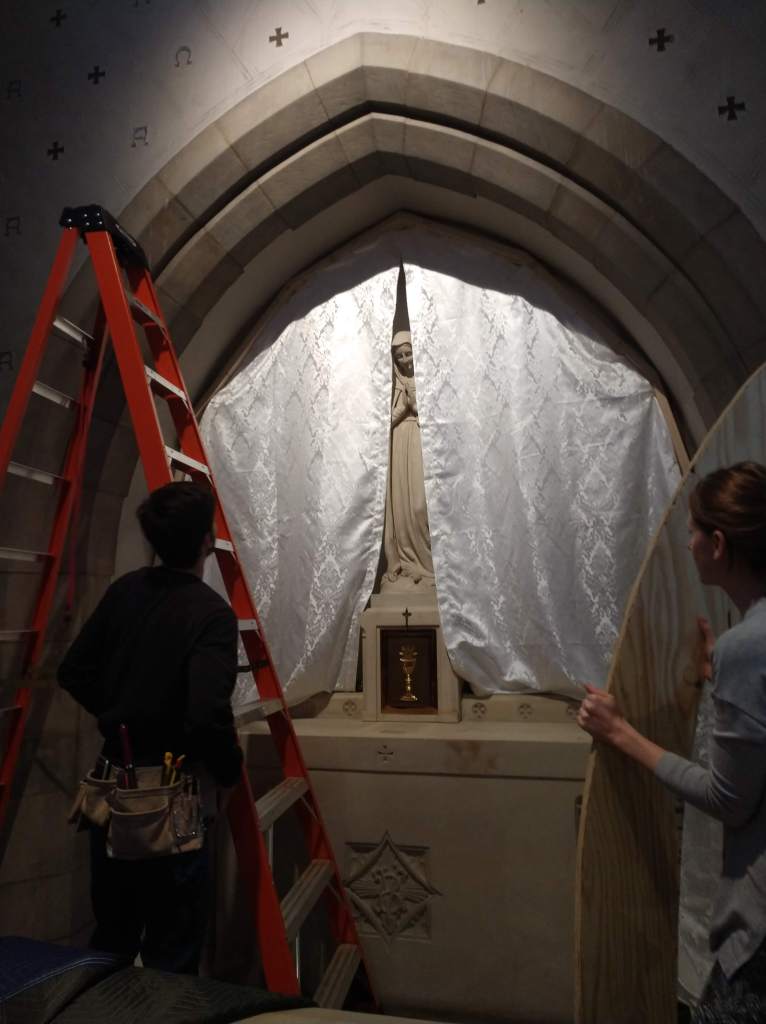
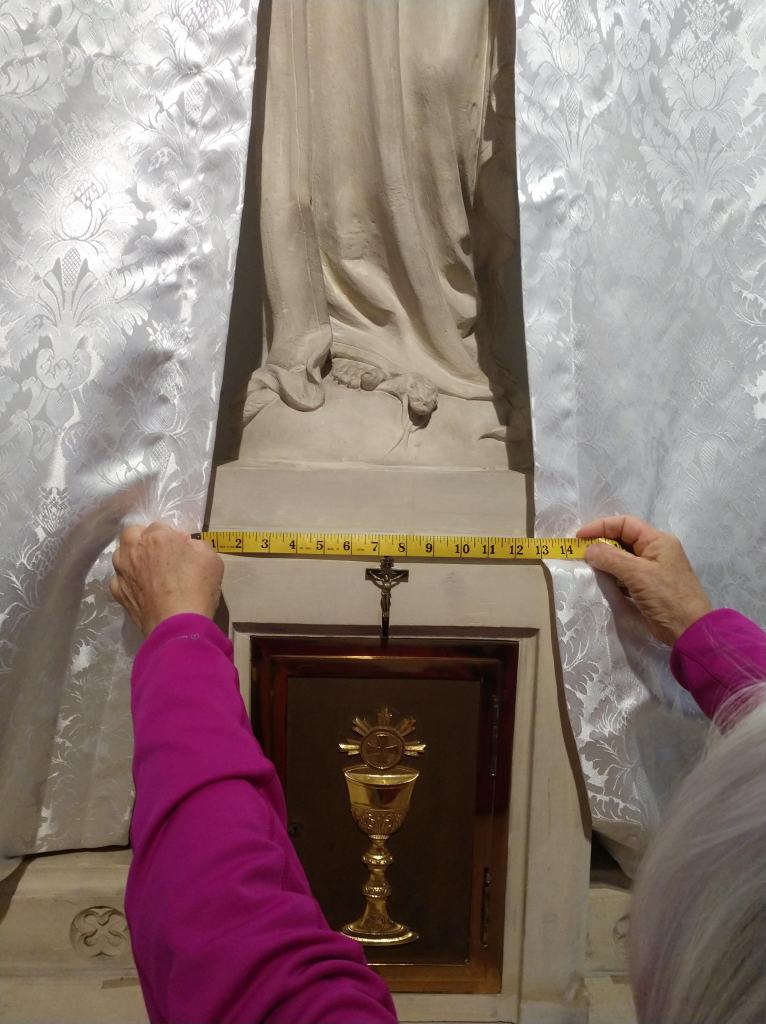
And here you see the mistake! I measured sloppily, and when the curtains went up on the frame’s little gold hooks, they didn’t actually cover Our Lady as intended! Ouch. Fortunately, my main seamstress was able to add a cuff extension to each panel. Crisis averted.
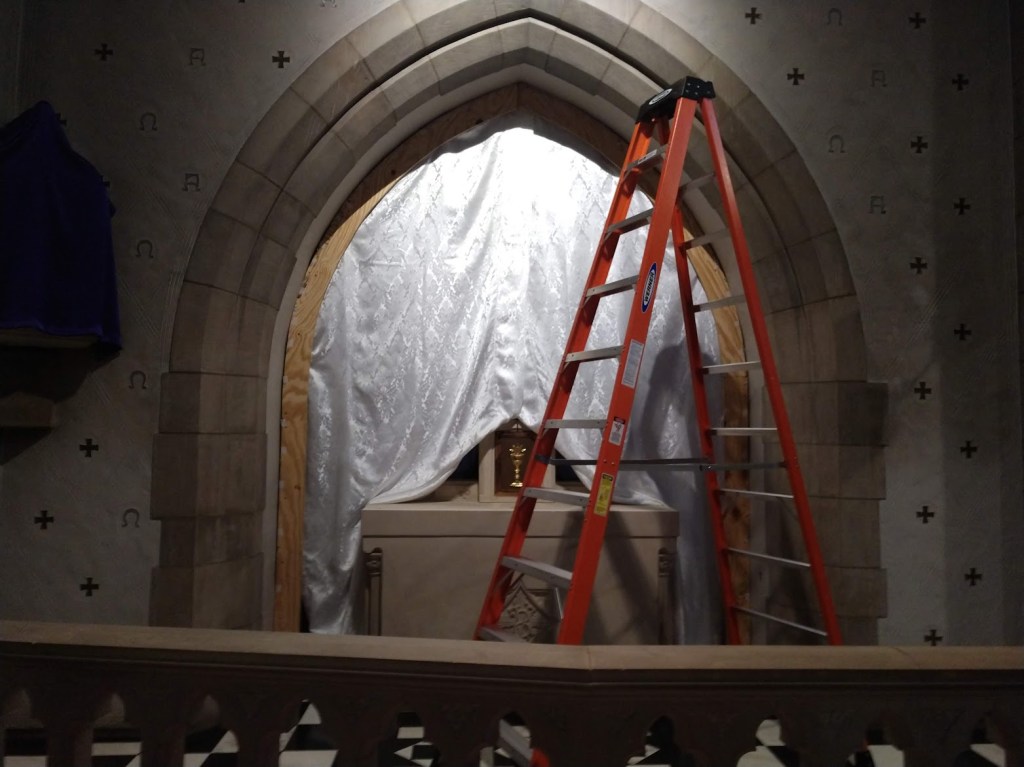
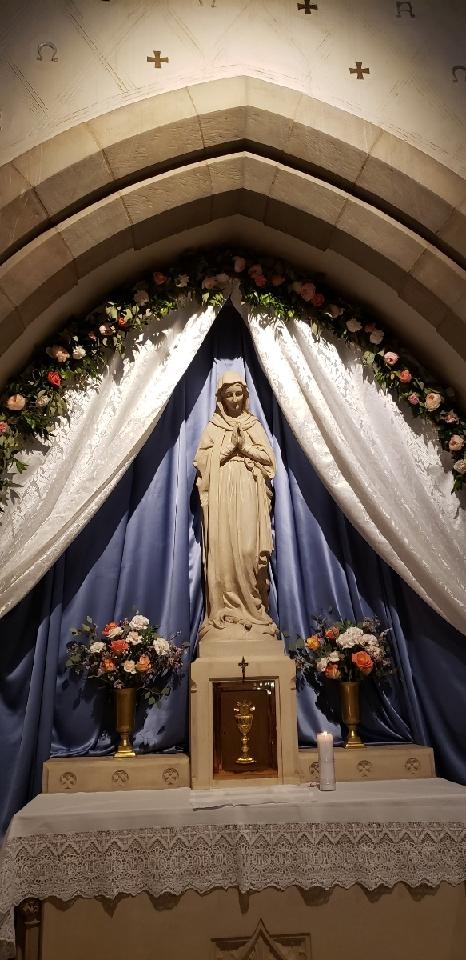
Above you can see, how the curtains are supposed to work. They fall around the Tabernacle and completely cover Our Lady.
My sewing team also made a beautiful cornice cover of the same fabric to cover the exposed wood you see above.
But there’s another fabric story with this project. I wanted fabric to hang behind Our Lady so that at the Easter Vigil when statues were unveiled, the altar boys could draw the curtains in front of Our Lady and reveal her and a beautiful backdrop. So, rather than taking everything down after Maundy Thursday, the alcove would take on a new life as a sort of Regina Ceali Easter shrine.
It took me a long time to choose a fabric. For this, I did go with silk (charmuese because of its wondrous liquid drape), but my first color choice was a complete failure. I thought taupe was a good idea and ordered 25 yards of it. Then I realized the statue completely blends in with taupe. Silly me. That taupe silk will one day become a ball gown for me. Hey, I really did try to give it to God…
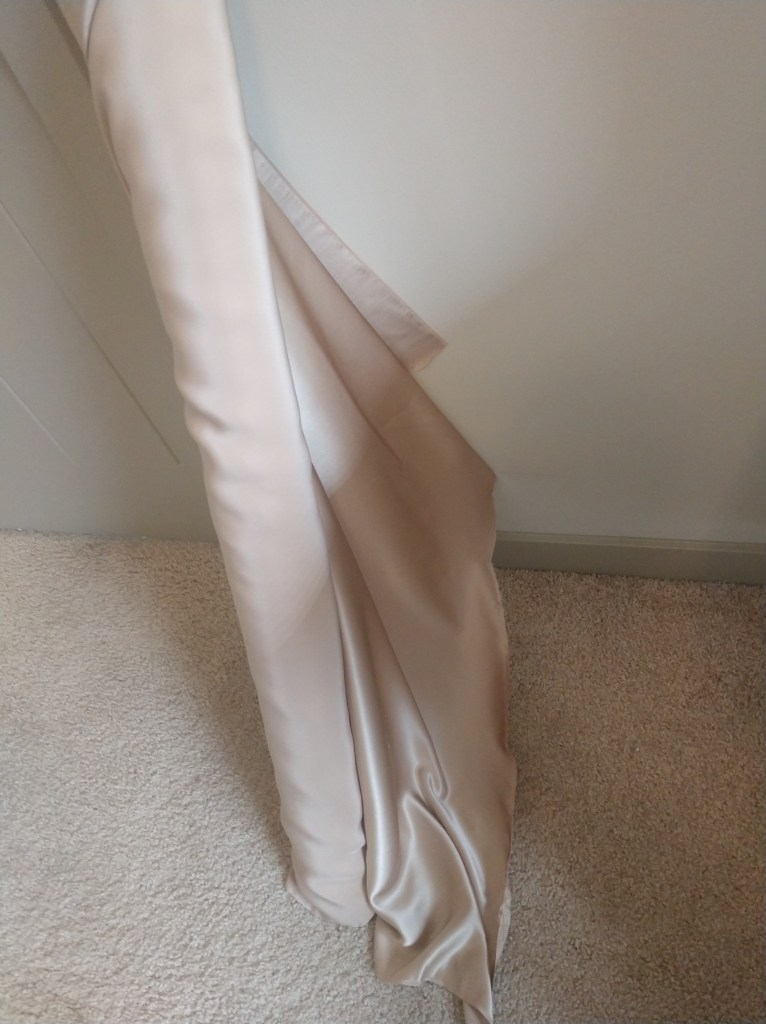
Here it is tested near a St. Joseph statue:
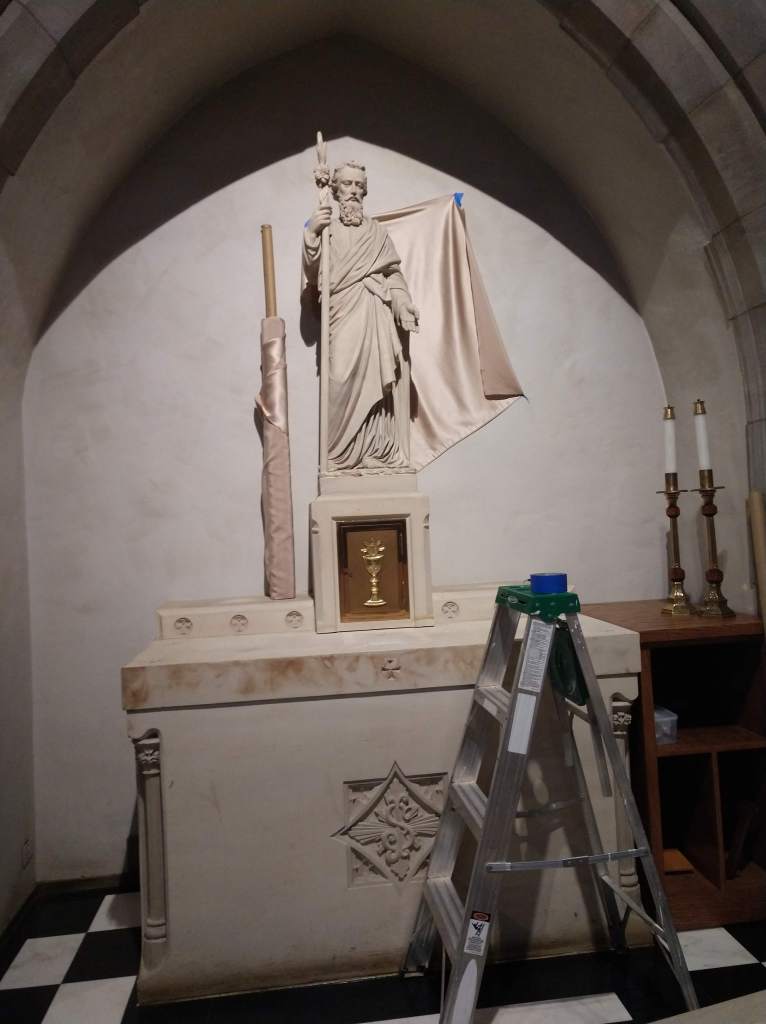
Way too similar to the warm color of the statue! But do you see why I love charmeuse? It’s the fabric equivalent of melted chocolate. Unbelievably lustrous.
I continued looking at colors that would contrast well with the statue; I got on the blue trail and started testing various shades.
A friend of mine made me angry when he called this shade, “Finding Nemo,” but of course he was right. This was way too vivid.
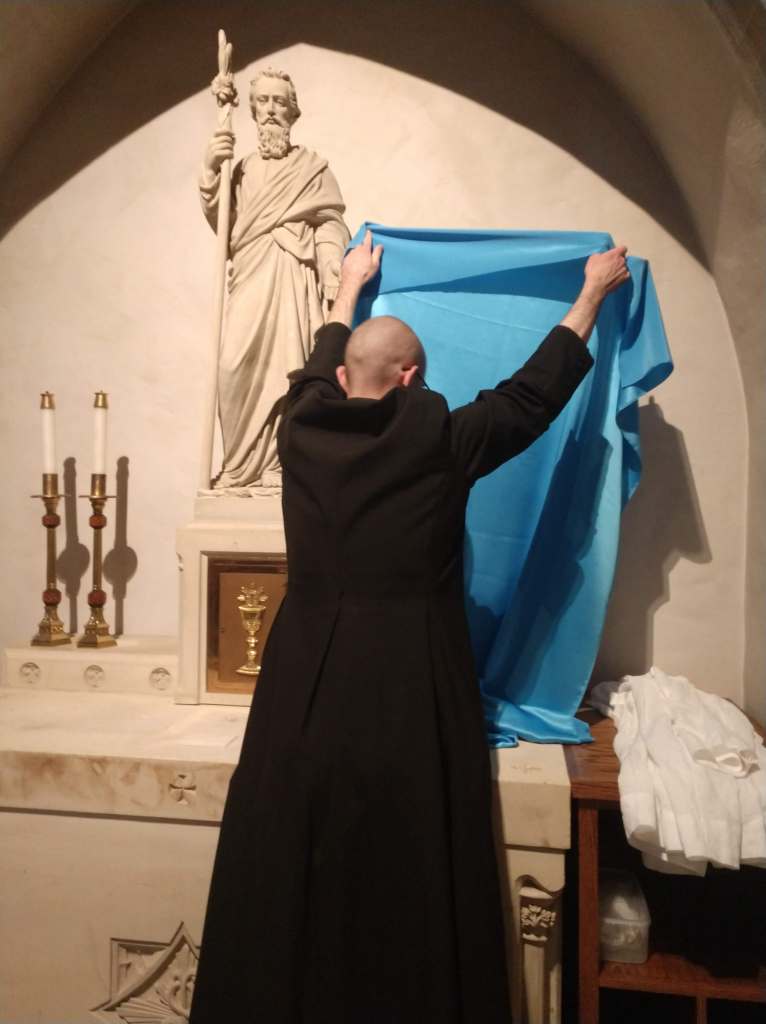
(It ended up becoming a sash for-you guessed it–a ballgown. I happily take Our Lord’s rejects.) A painter friend advised me to choose a more neutral blue, one with “earth tones.” When I found one called “Stone Washed Blue,” I realized I had found my color. Here’s my three blue samples, with the Stone Washed in the center:

Testing near the statue:
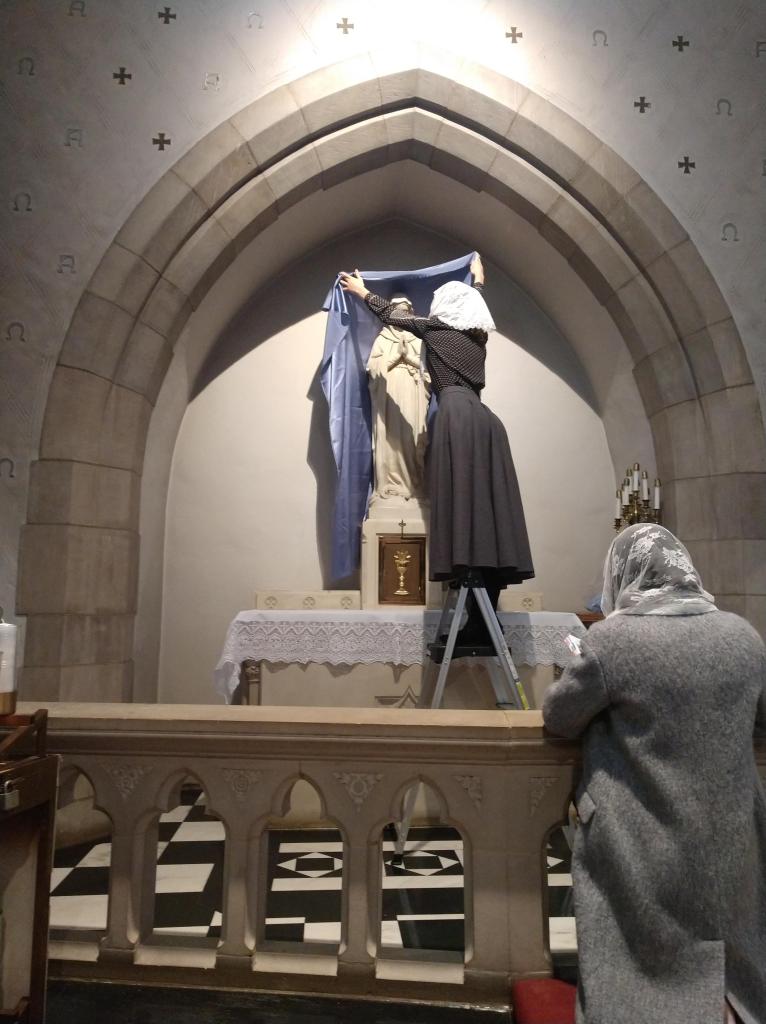
Funny, in that light it takes on this almost lavender color.
All this planning took place during Lent. But on Spy Wednesday, it’s go time. That’s when things come together:
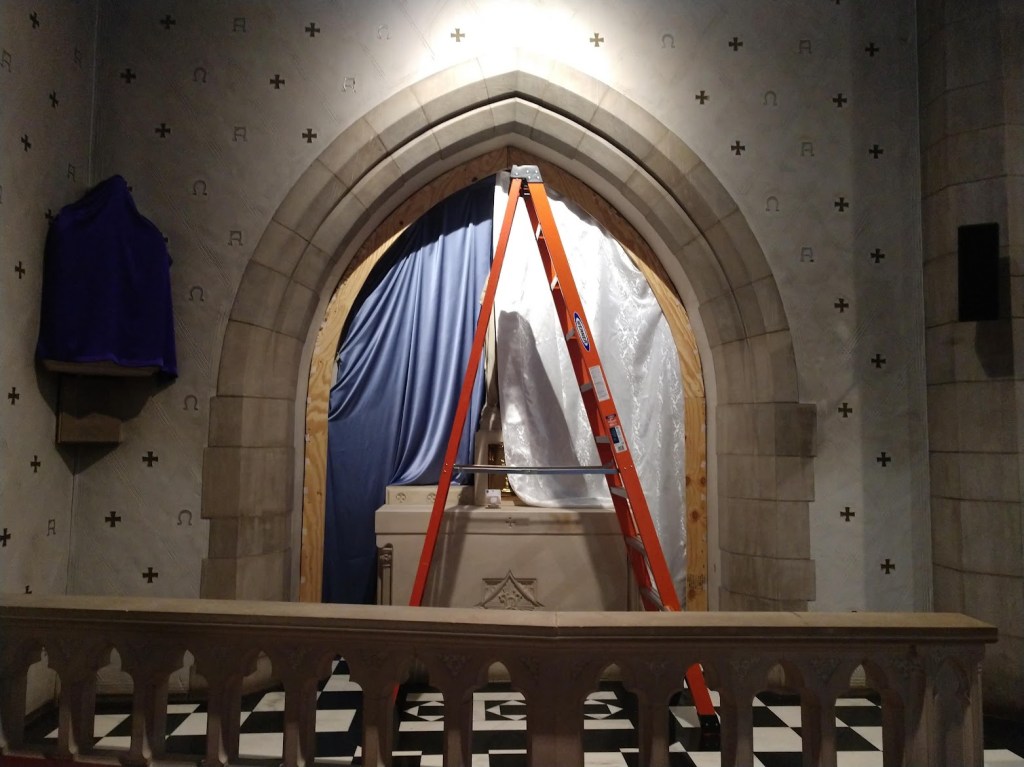
Here you see the blue silk hanging behind our Lady (look at the drape of that charmeuse!) and one white damask panel in place. The curtain hanging requires great agility on the ladder. I do sometimes stand barefoot on the gradine (the shelf where the candles usually go), but this I only do when absolutely necessary, and I never stand on the altar mensa itself.
Now to talk about flowers.
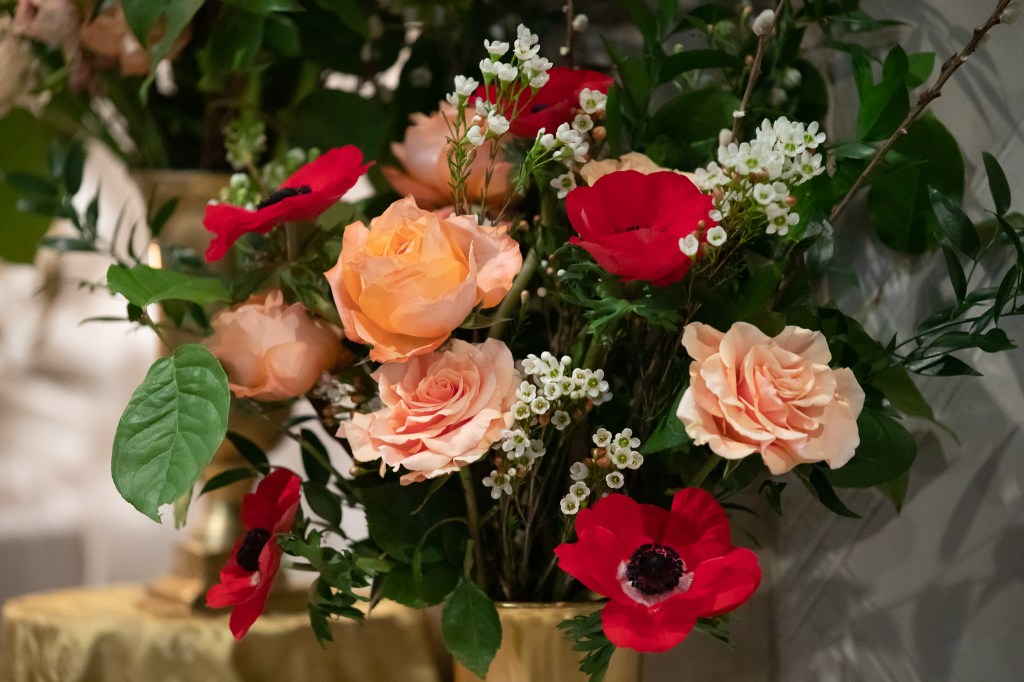
All along, I had dreamed of having a garland of fresh flowers framing the entire alcove. I ordered a garland of greens (primarily Ruscus) and then added roses with tubes of water on their stems. Of course I did standard arrangements as well. Spy Wednesday is the big flower day. I feel wonderfully close to my dear Maria Magdalena on this day. As she went about Jerusalem finding the finest spikenard for Our Lord, I busy myself with the flowers also for Him.
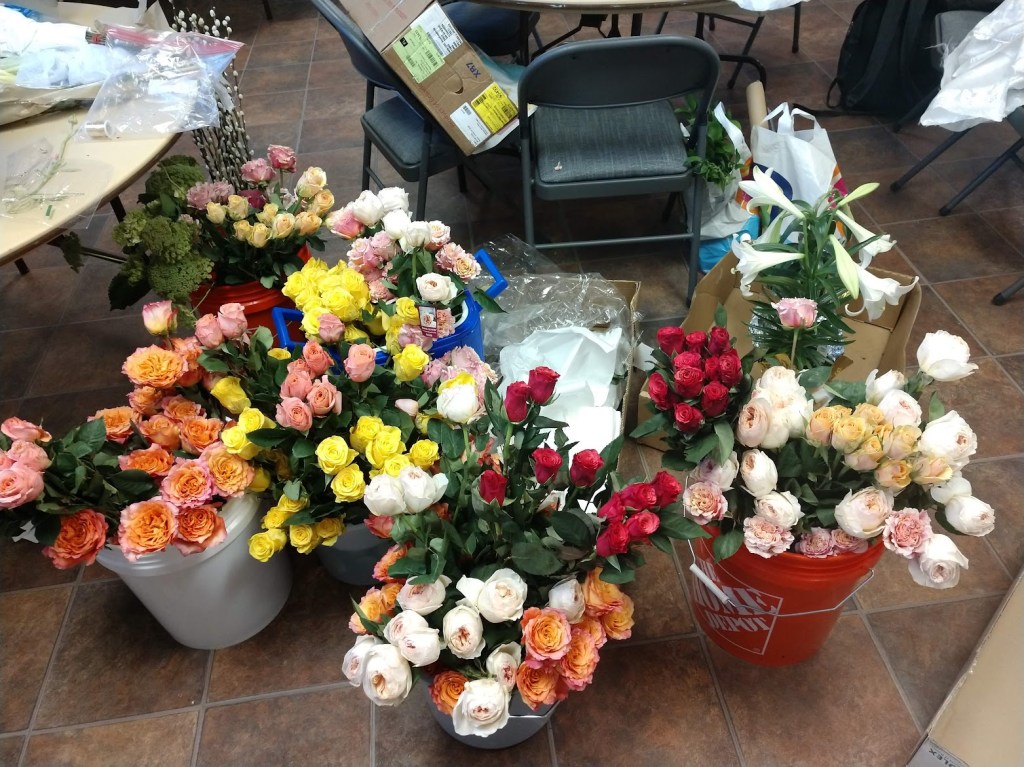
I absolutely love garden roses. Peonies too. Pussy willow, potted Easter Lilies, and lots of other fillers.
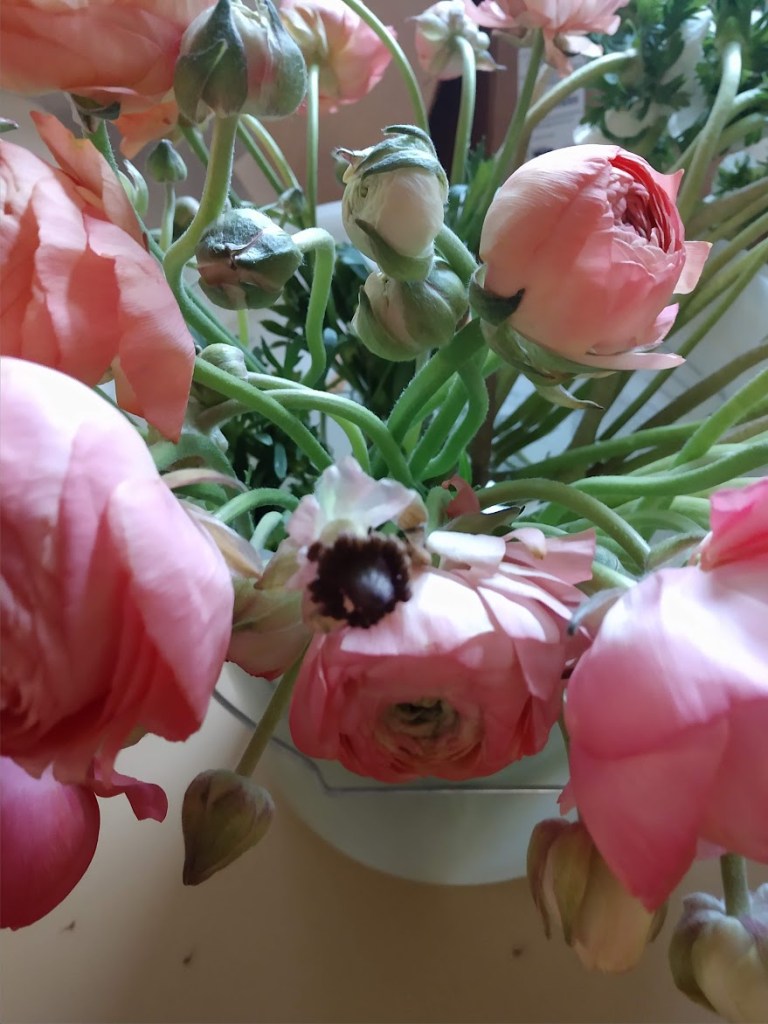
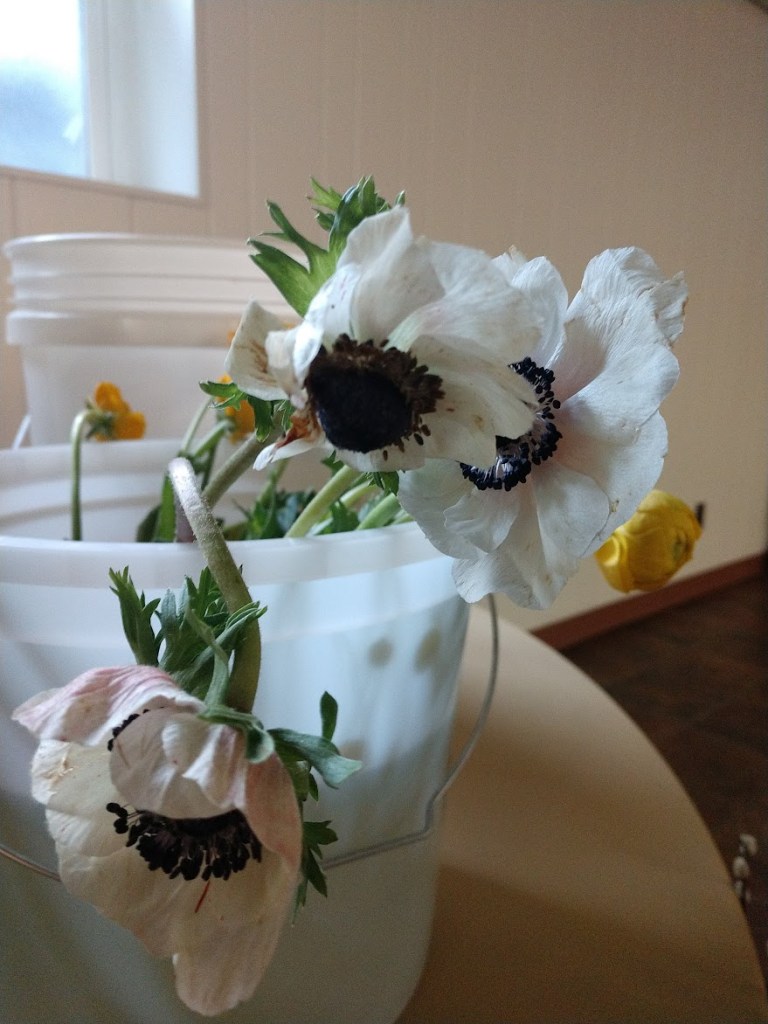
The panda anemones aren’t doing too well. That was the year all my flowers got lost in the mail and came too late and looking very bedraggled.
I had to run to my local wholesaler and buy everything from scratch at the last minute.
But speaking of anemones. The reason why I use them is because they symbolize the Passion. The red ones especially speak of the Precious Blood. The white ones, I like to think of as speaking of the Sorrowful Mother–pure with a deep, sorrowful heart.
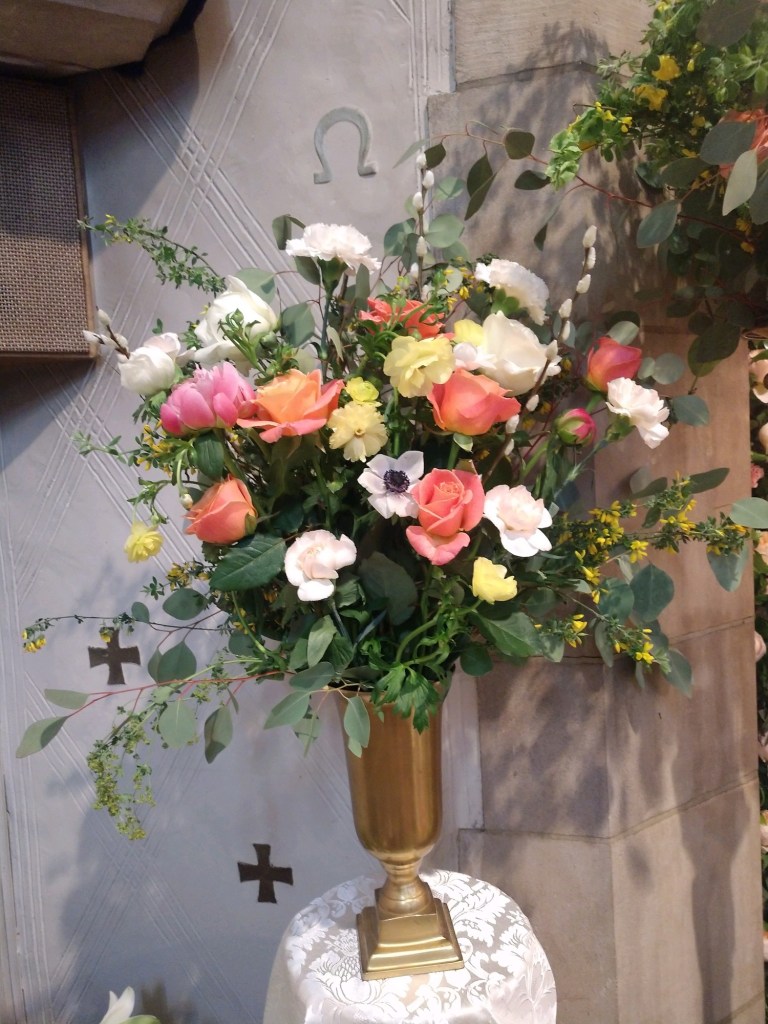
There was another little side project that came to me as I planned the altar of repose. That was to decorate my candelabra. At the Cathedral Basilica of Saint Louis, I saw a hanging from the arms of a Crucifix, crystal pendants like what one might see on a candle sconce or dinner candelabra of a rich old house. I thought this absolutely gorgeous. My candelabra are just basic rather tarnished brass ones.
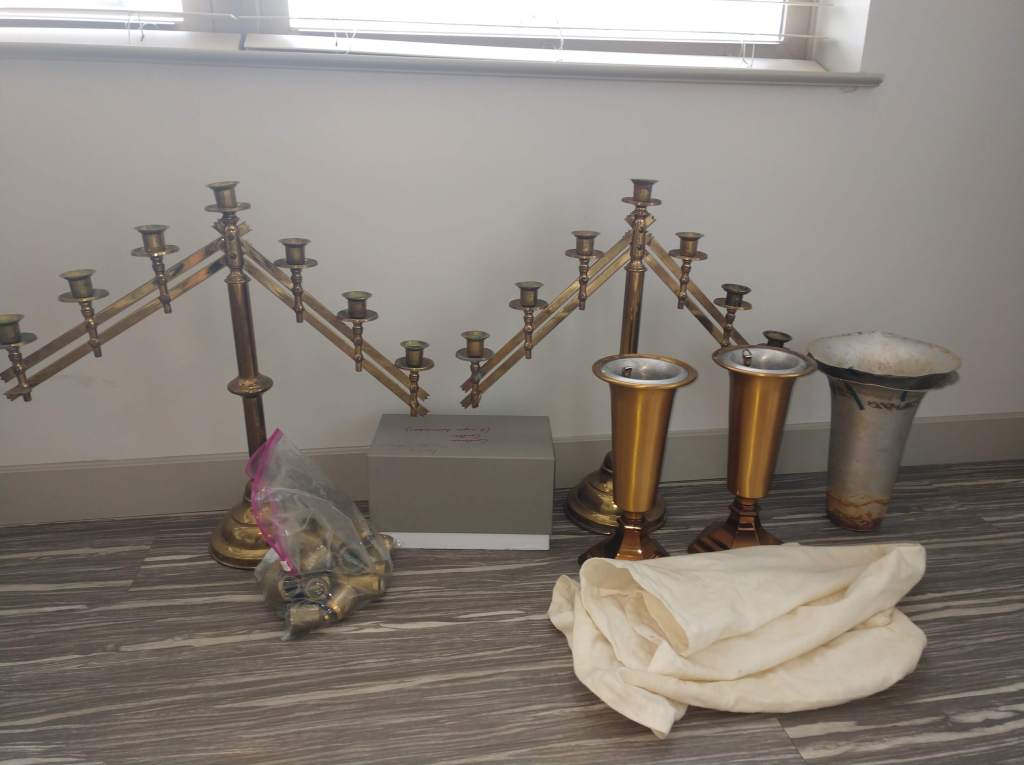
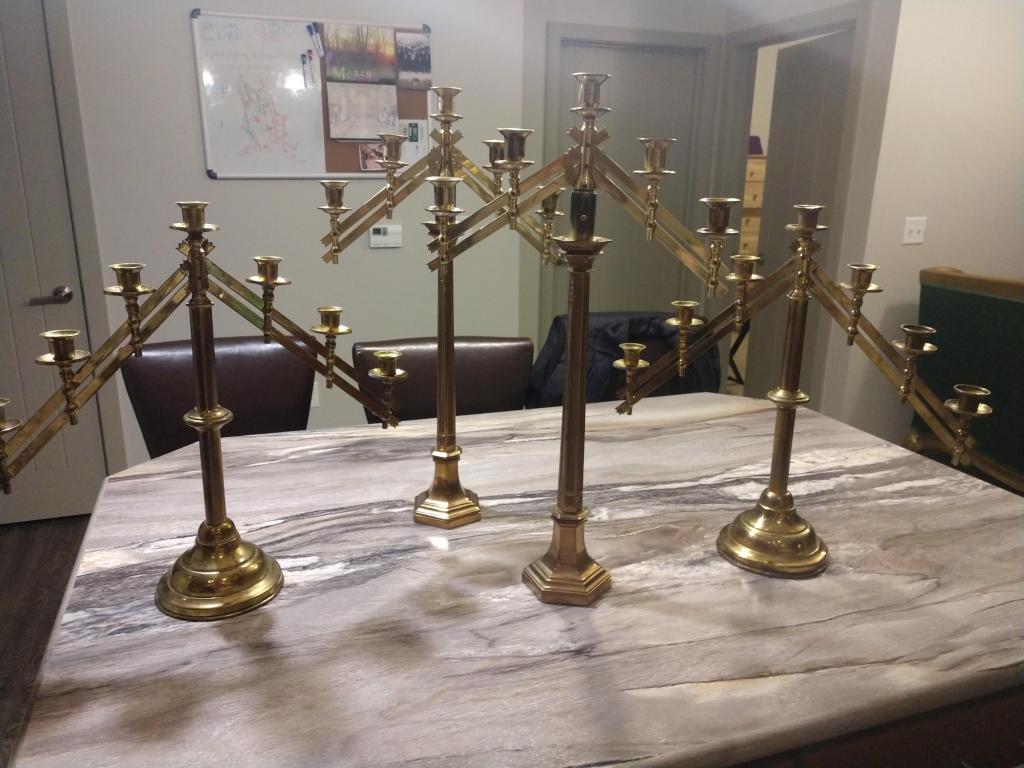
But I figured that some glass pendents and freshwater pearls could make them worthier to adorn the altar. So, while working from home (letting code compile) I did liturgical beading:
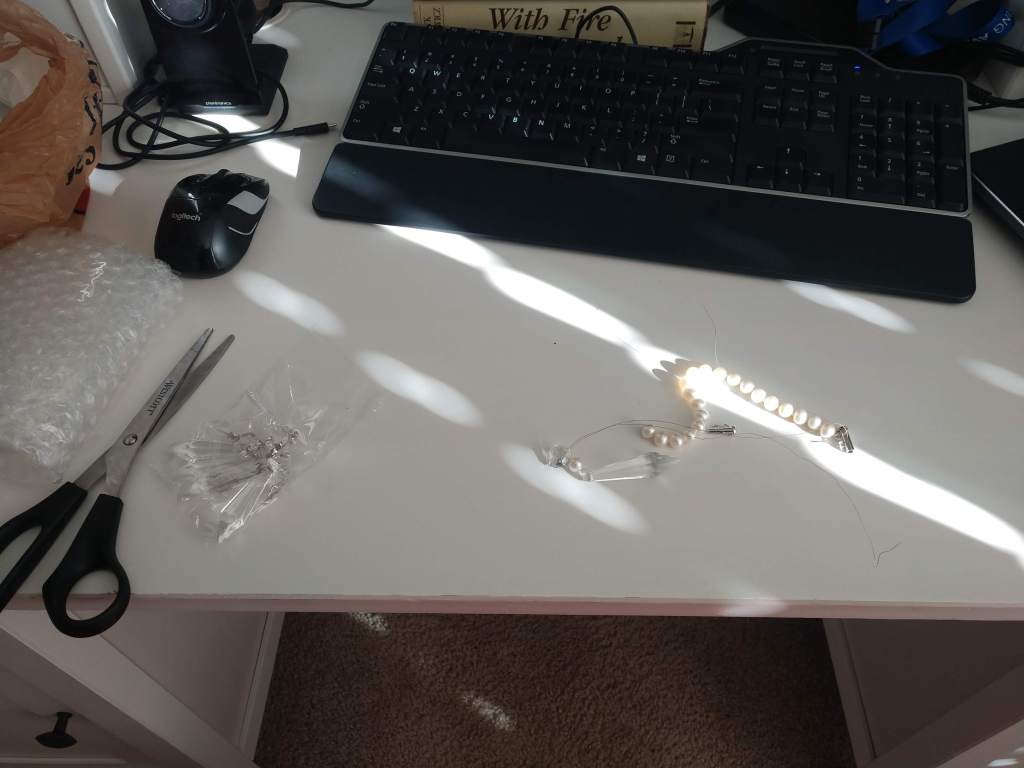
It was a sunny winter day! I willed that compiler to be slow. More beading for me!
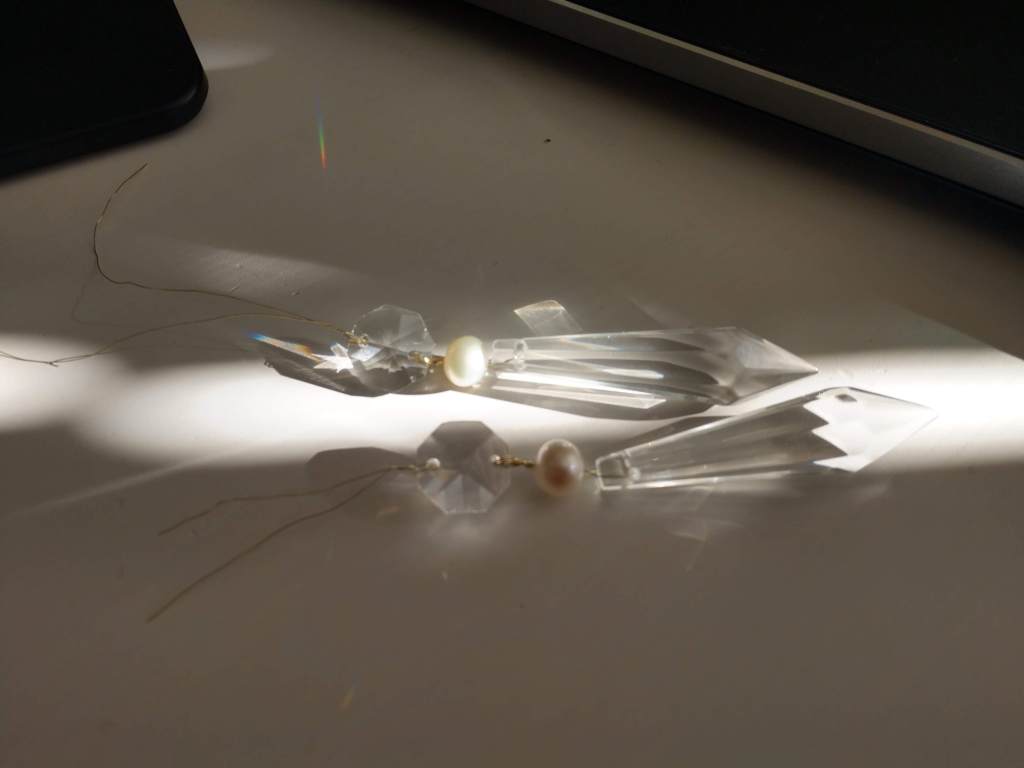
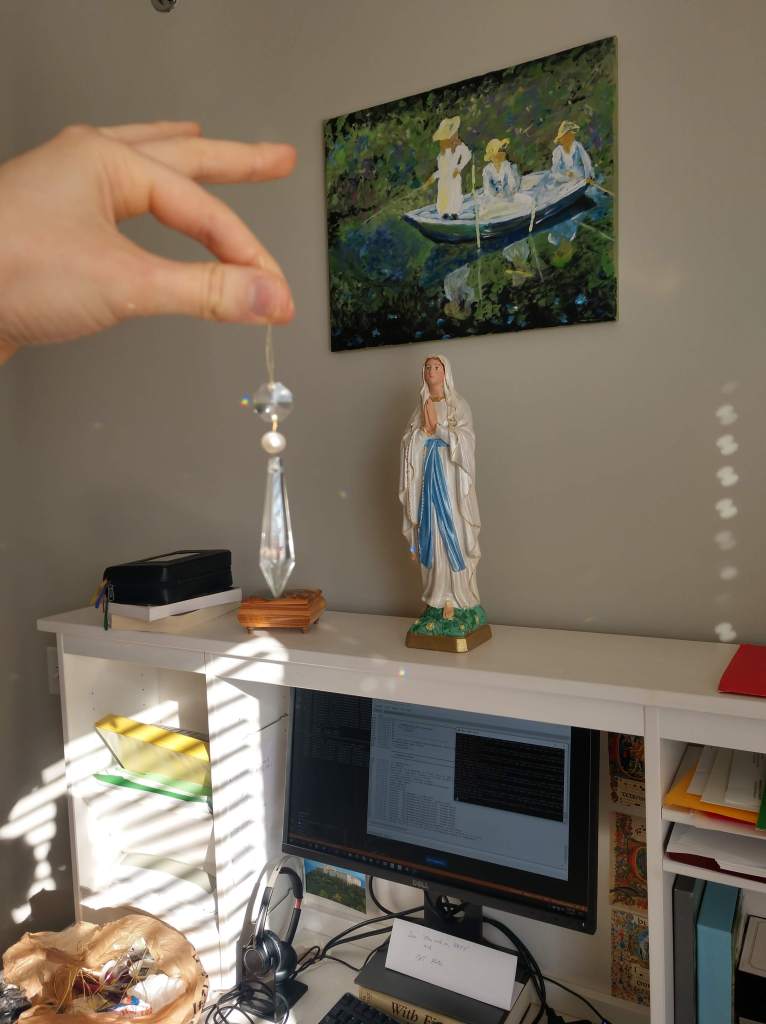
This is what I attached under each candle socket using a little bit of thin brass wire.
But wait, there’s more! All the way back in Christmastide I experimented with ostrich plumes. These are traditional for Eucharistic symbolism. Ostrich plumes are for Kings, to fan them (think of the papal flabella).
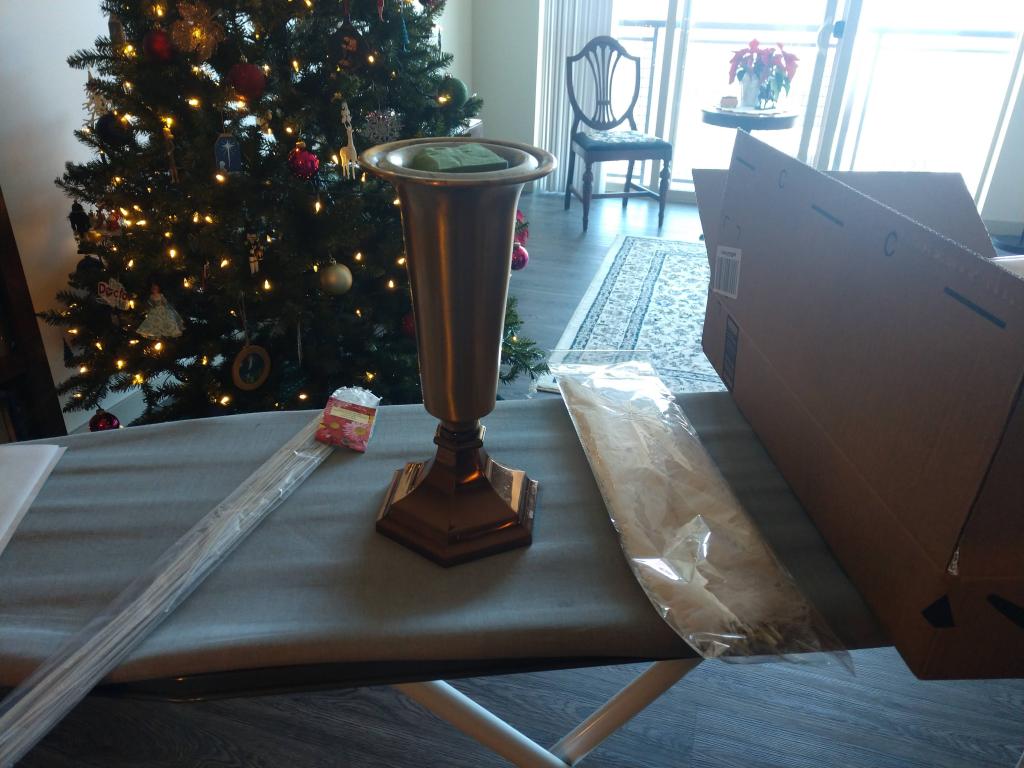
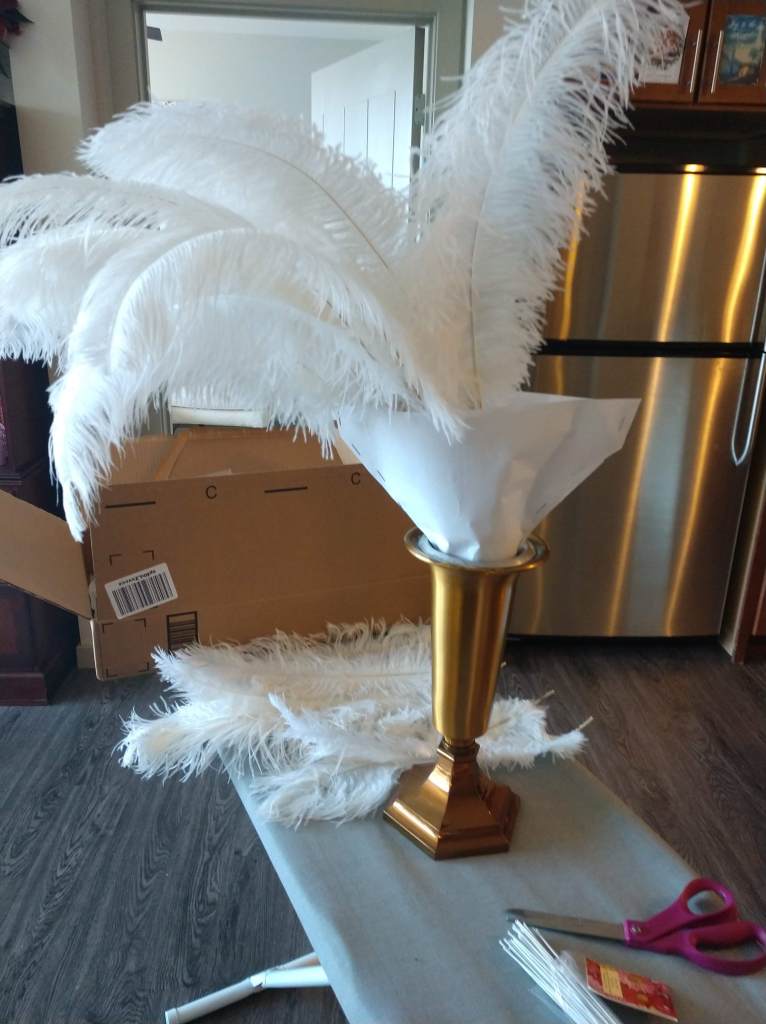
I never did feel content with the feather in a vase look. Up to the very last minute, I did not know how to incorporate my ostrich plumes.
Then, I had an epiphany! I looked at a calendar from the Institute of Christ the King’s Altar of Repose at their seminary in Gricigliano, and there it was: They had made a crest of feathers and put it right on top of their tabernacle. This idea was a gift from God. He was truly helping me beautify His dwelling.
So, putting it all together. The photos below are from the three years I’ve had the privilege to do this (2021, 2022, and 2023). Each year, it has gotten better and better. The first year, I did not have the gold antependium or the gold silk drapes which I hang around the tabernacle. Nor did I have the ceramic flower candelabra. And only the third year did I think to do the sweeping arrangements on each side of the tabernacle. These are all game-changers.
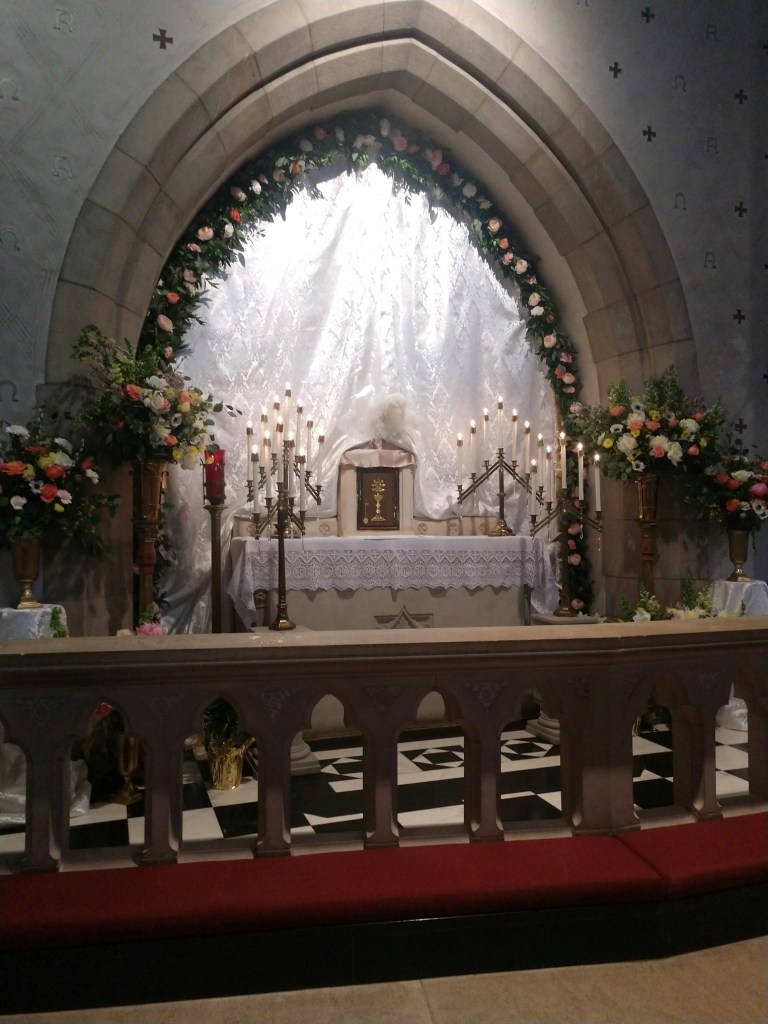
Here it is year 1 (2021).
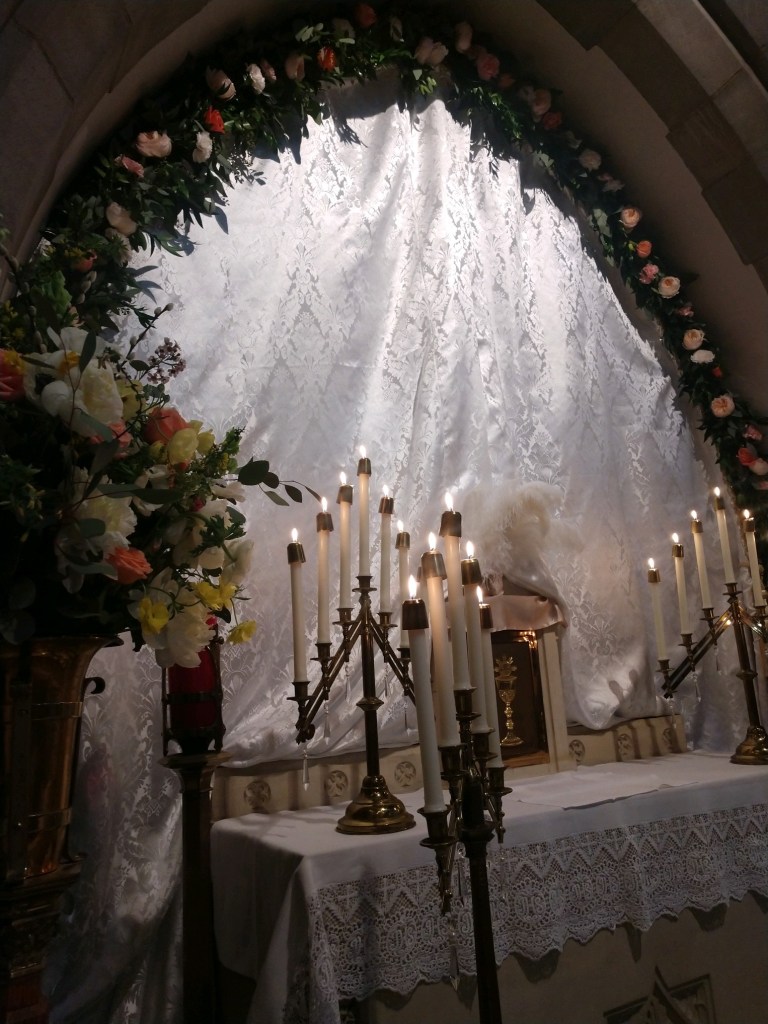
There’s a better view of the glass pendents and the ostrich crest.
And on Holy Saturday at the unveiling, the curtains were drawn and there was Our Lady with the Stone-washed Blue silk charmeuse!
Since 2022 was a transitional year, I’m skipping right to 2023 now. The best one yet!
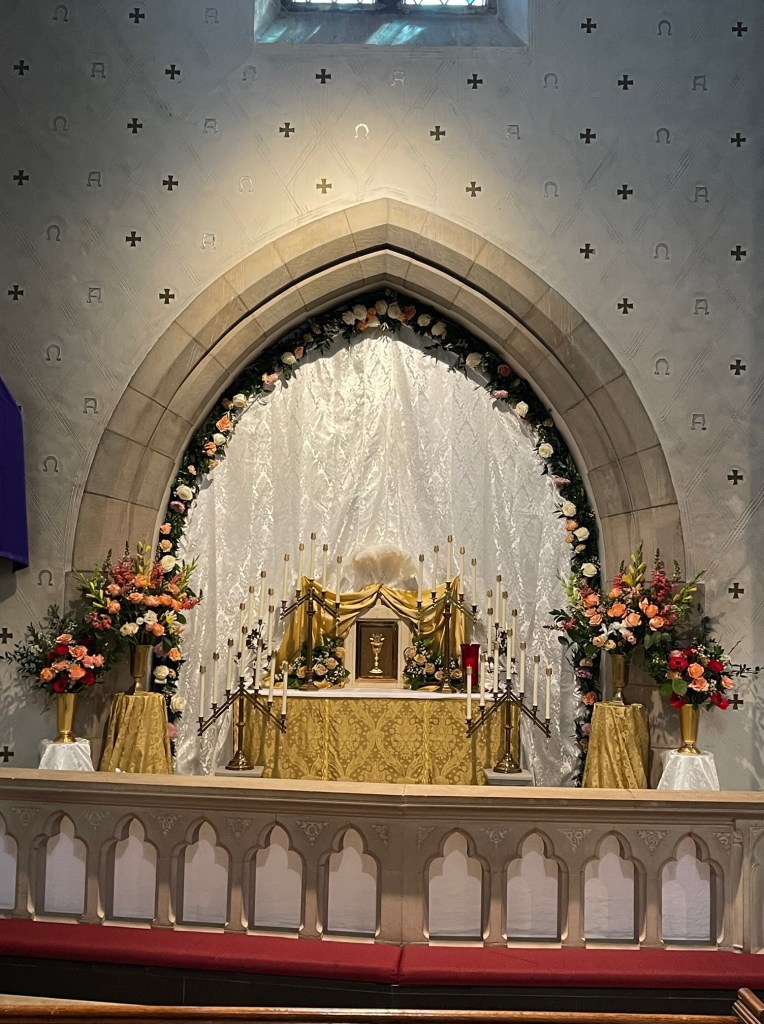
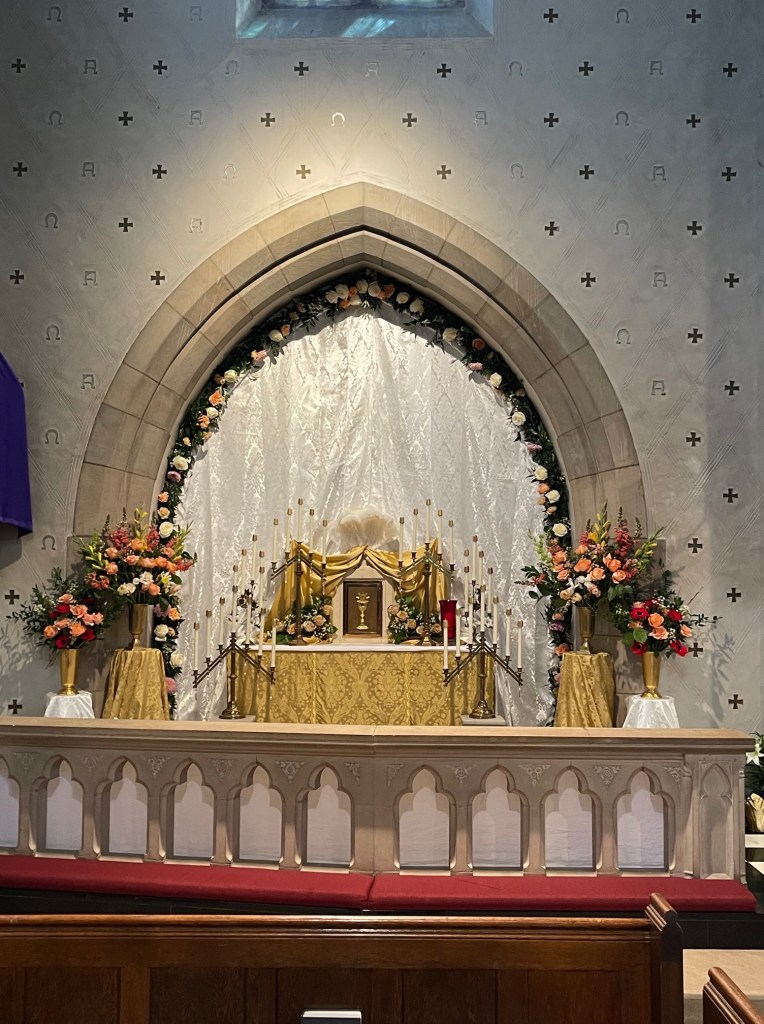
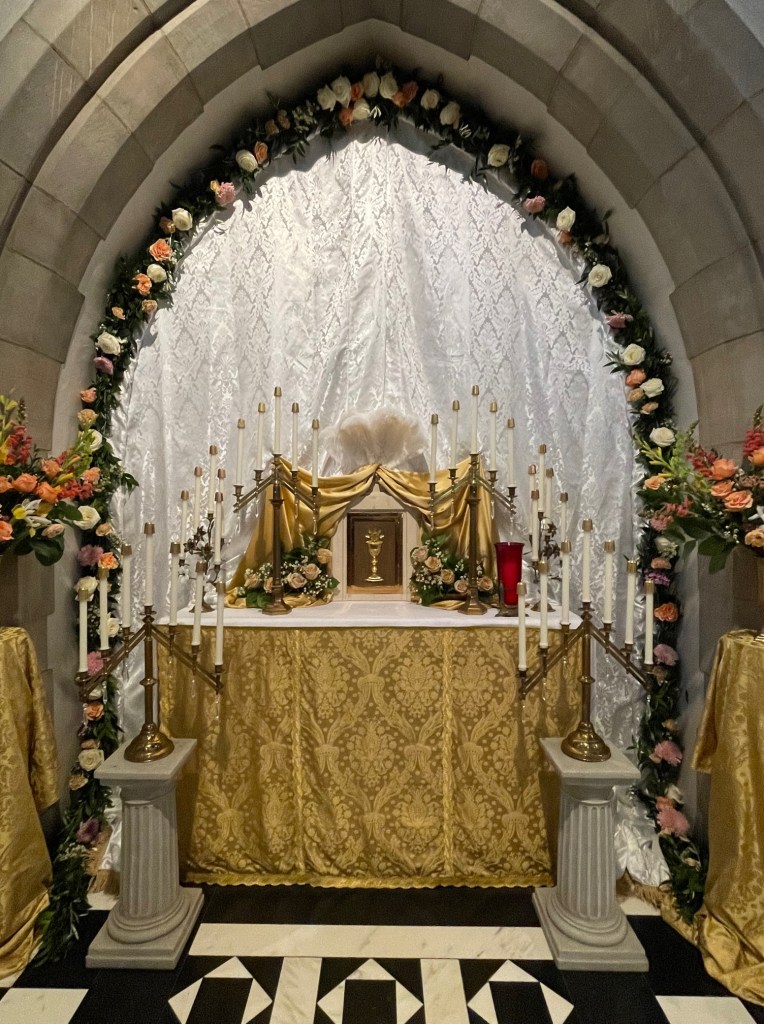
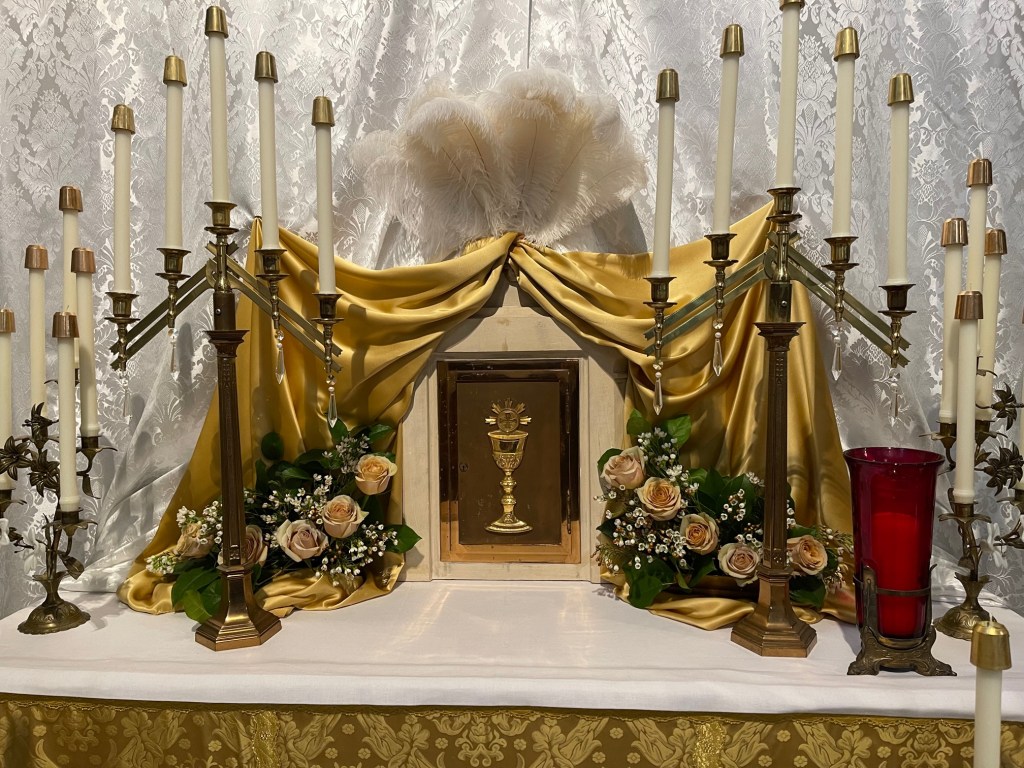
Note the little tripod sanctuary lamp I use. It is antique brass with each foot being a grotesque little creature with its heads resting on its paws! You can also see the lovely brass and ceramic floral candelabra.
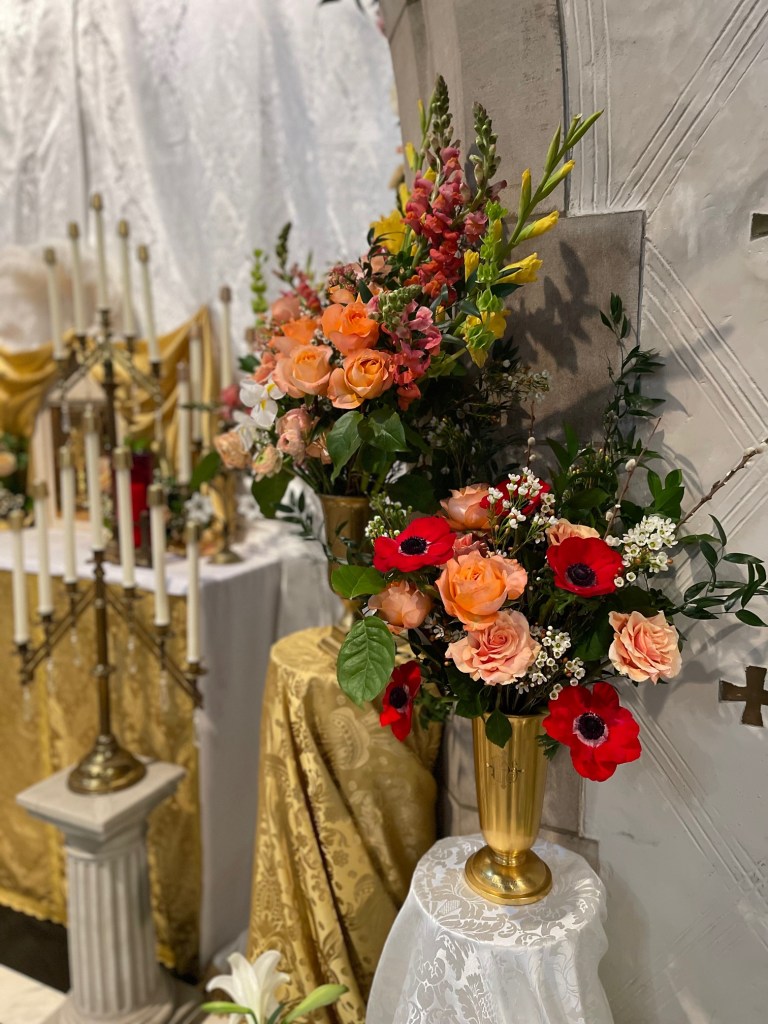
Below photos courtesy of Mrs. Kiera Petrick.
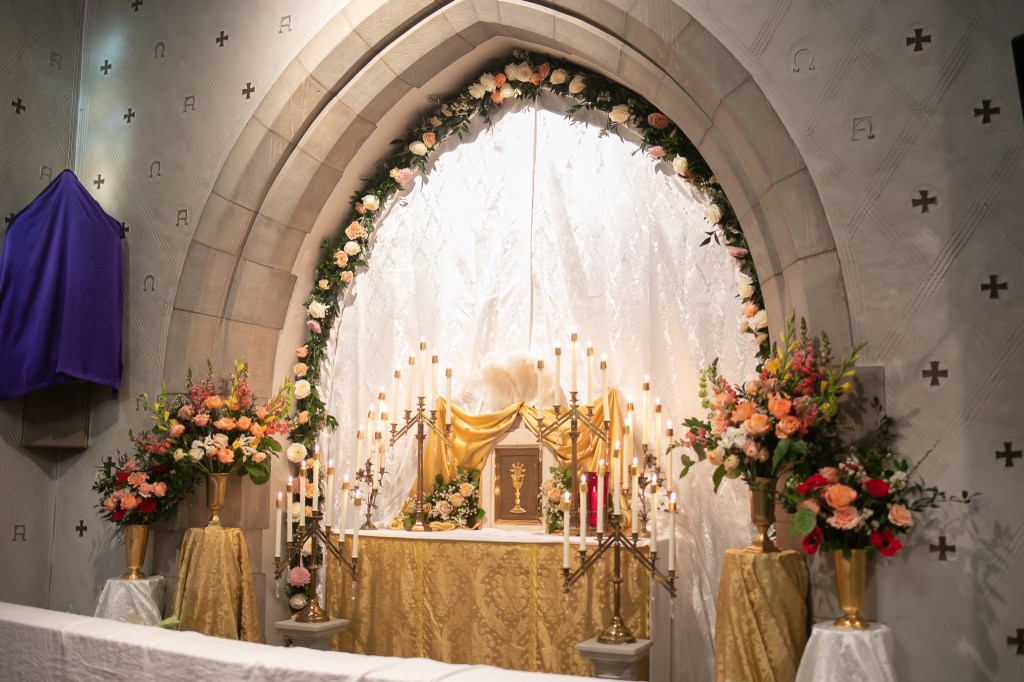
Ah! Can’t get enough of that gold silk!
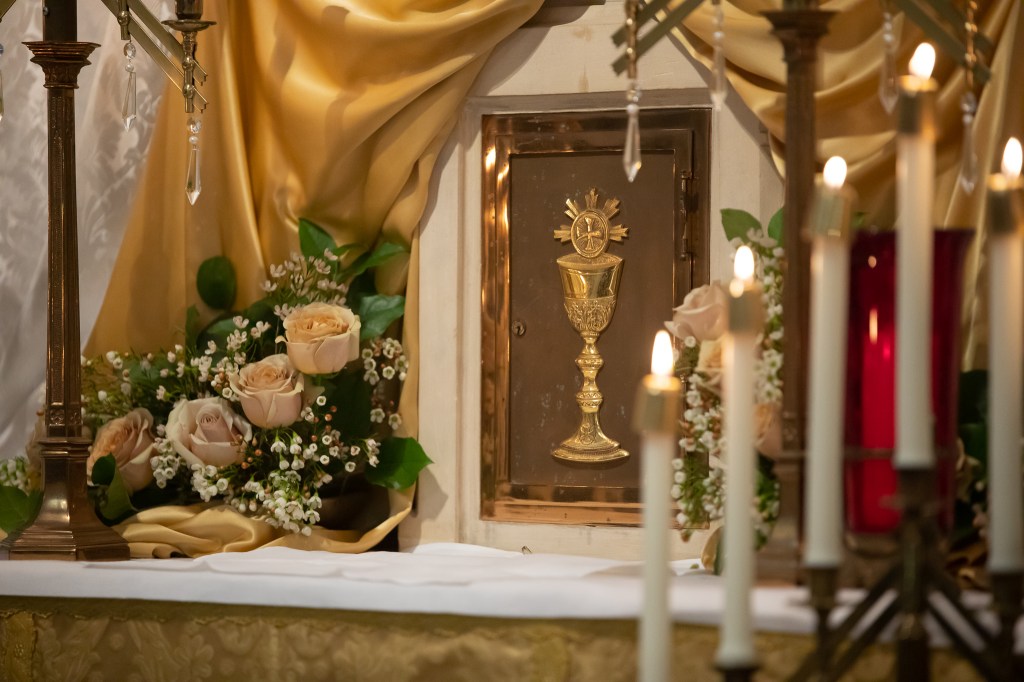
I think my favorite part were these arrangements which I nuzzled up next to the tabernacle. The roses are called “Golden Mustard” roses. What lucky roses! Can a rose have any greater destiny than this?
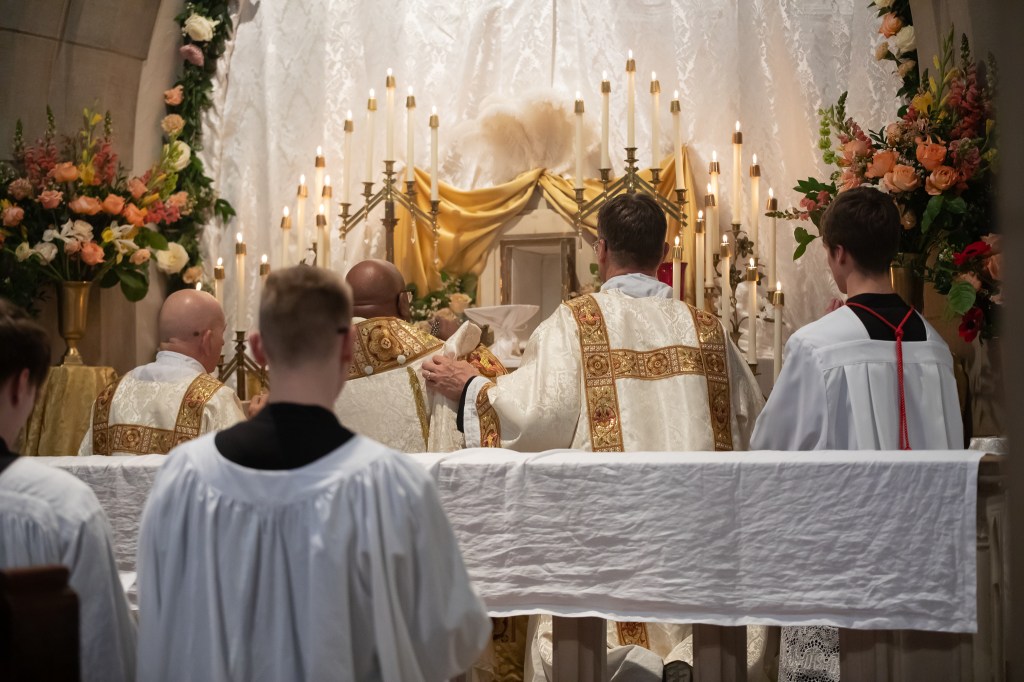
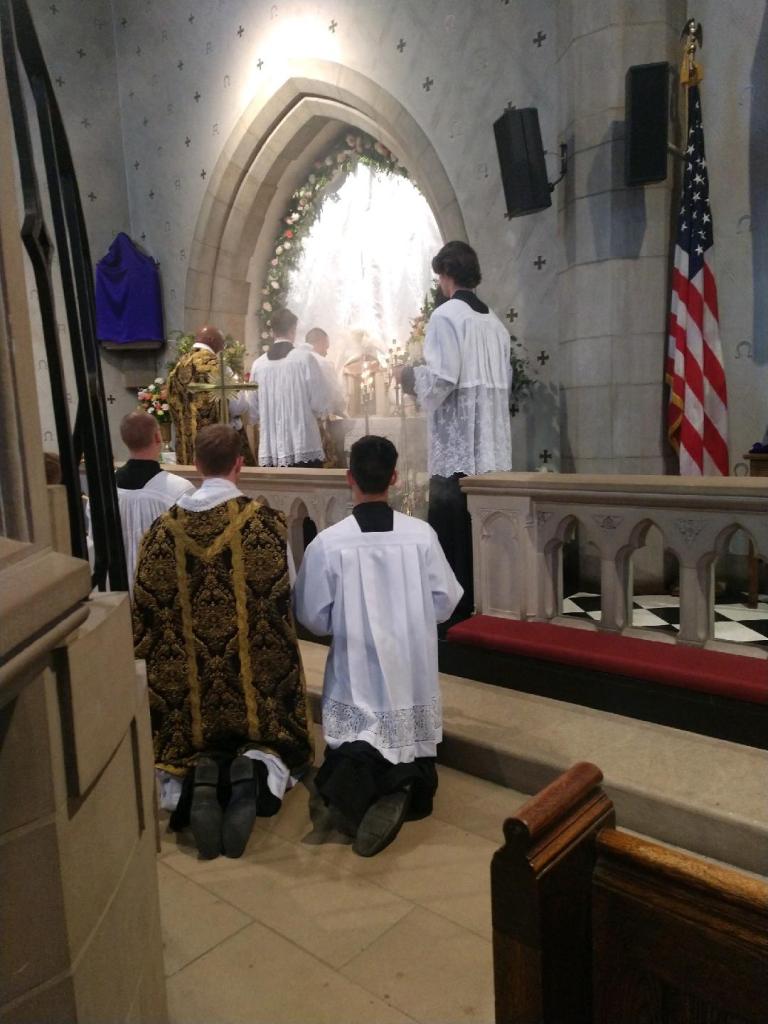
The thing that makes a liturgical artist’s heart burst with joy – Seeing the art used for the intended purpose in the liturgy. And praying fervently none of these men knock something over!
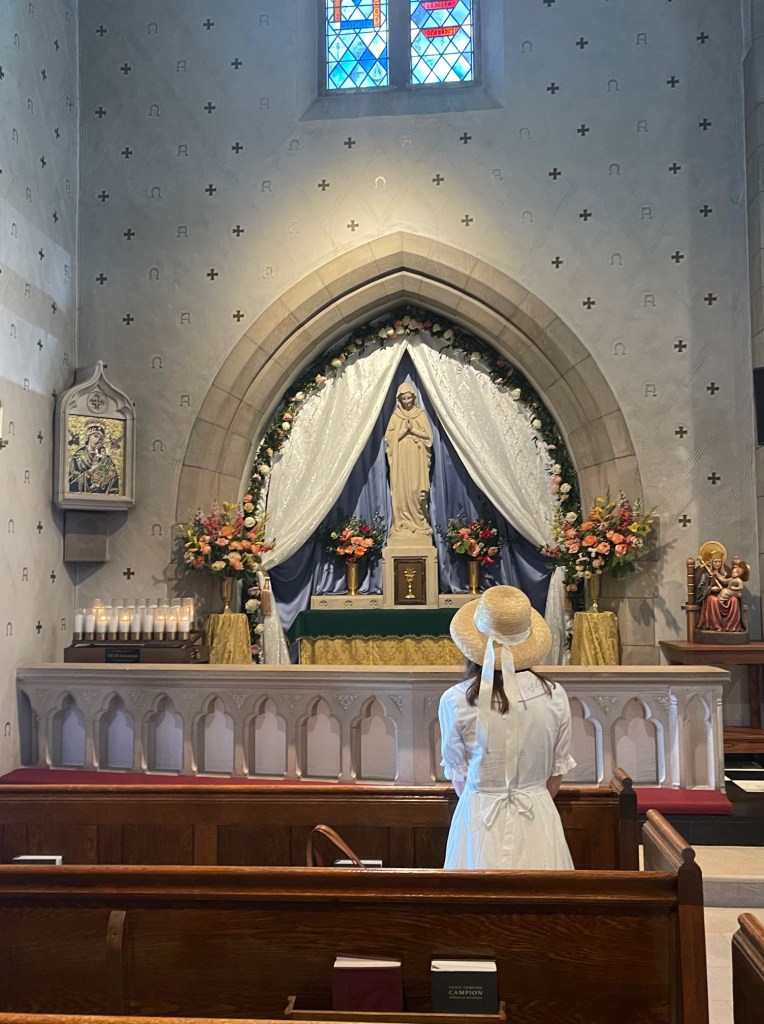
My mom caught me praying here at the shrine on Easter Monday. The Eucharist is no longer reserved here. You can see how the arrangements now serve as Easter flowers.
What’s next for 2024? Who knows, but it must get better every year. Remember, if you don’t do more, you do less. And when it comes to Altars of Repose, there’s no such thing as extravagance!
 Embracing All Things Beautiful